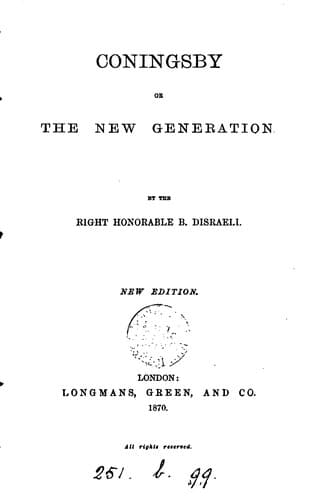
Coningsby; Or, The New GenerationDisraeli, Benjamin, Earl of Beaconsfield
General
Coningsby; Or, The New Generation
Disraeli, Benjamin, Earl of Beaconsfield
Great Britain -- Fiction; Political fiction; Politicians -- Fiction
In less than a fortnight’s time the House of Lords, like James II.,
having abdicated their functions by absence, the Reform Bill passed; the
ardent monarch, who a few months before had expressed his readiness to
go down to Parliament, in a hackney coach if necessary, to assist its
progress, now declining personally to give his assent to its provisions.
In the protracted discussions to which this celebrated measure gave
rise, nothing is more remarkable than the perplexities into which the
speakers of both sides are thrown, when they touch upon the nature of
the representative principle. On one hand it was maintained, that, under
the old system, the people were virtually represented; while on the
other, it was triumphantly urged, that if the principle be conceded, the
people should not be virtually, but actually, represented. But who are
the people? And where are you to draw a line? And why should there
be any? It was urged that a contribution to the taxes was the
constitutional qualification for the suffrage. But we have established
a system of taxation in this country of so remarkable a nature, that the
beggar who chews his quid as he sweeps a crossing, is contributing
to the imposts! Is he to have a vote? He is one of the people, and he
yields his quota to the public burthens.
Amid these conflicting statements, and these confounding conclusions, it
is singular that no member of either House should have recurred to
the original character of these popular assemblies, which have always
prevailed among the northern nations. We still retain in the antique
phraseology of our statutes the term which might have beneficially
guided a modern Reformer in his reconstructive labours.
When the crowned Northman consulted on the welfare of his kingdom, he
assembled the ESTATES of his realm. Now an estate is a class of the
nation invested with political rights. There appeared the estate of the
clergy, of the barons, of other classes. In the Scandinavian kingdoms
to this day, the estate of the peasants sends its representatives to the
Diet. In England, under the Normans, the Church and the Baronage were
convoked, together with the estate of the Community, a term which then
probably described the inferior holders of land, whose tenure was
not immediate of the Crown. This Third Estate was so numerous, that
convenience suggested its appearance by representation; while the
others, more limited, appeared, and still appear, personally. The Third
Estate was reconstructed as circumstances developed themselves. It was a
Reform of Parliament when the towns were summoned.
Public-domain text, read in full here on John Shaqi.
Reviews
Reviews
No reviews yet
Be the first to share your thoughts on this work.
Join the Discussion
Join the discussion
Sign in to leave a comment or review.
Sign InorCreate an account