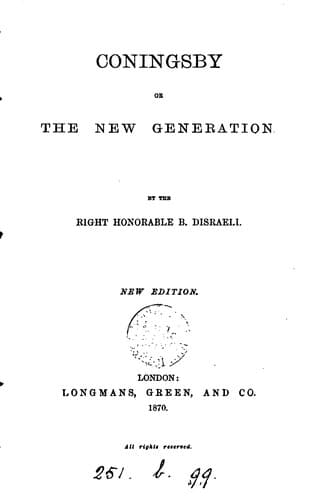
Coningsby; Or, The New GenerationDisraeli, Benjamin, Earl of Beaconsfield
General
Coningsby; Or, The New Generation
Disraeli, Benjamin, Earl of Beaconsfield
Great Britain -- Fiction; Political fiction; Politicians -- Fiction
Lady Monmouth pointed to the seat which Flora had occupied.
‘I thank your Ladyship,’ said Mr. Rigby, with a somewhat grave and yet
perplexed expression of countenance, and seating himself at some little
distance from his companion, ‘but I am very well here.’
There was a pause. Instead of responding to the invitation of Lady
Monmouth to communicate with his usual readiness and volubility, Mr.
Rigby was silent, and, if it were possible to use such an expression
with regard to such a gentleman, apparently embarrassed.
‘Well,’ said Lady Monmouth, ‘does he know about the Millbanks?’
‘Everything,’ said Mr. Rigby.
‘And what did he say?’
‘His Lordship was greatly shocked,’ replied Mr. Rigby, with a pious
expression of features. ‘Such monstrous ingratitude! As his Lordship
very justly observed, “It is impossible to say what is going on under my
own roof, or to what I can trust.”’
‘But he made an exception in your favour, I dare say, my dear Mr.
Rigby,’ said Lady Monmouth.
‘Lord Monmouth was pleased to say that I possessed his entire
confidence,’ said Mr. Rigby, ‘and that he looked to me in his
difficulties.’
‘Very sensible of him. And what is to become of Mr. Coningsby?’
‘The steps which his Lordship is about to take with reference to the
establishment generally,’ said Mr. Rigby, ‘will allow the connection
that at present subsists between that gentleman and his noble relative,
now that Lord Monmouth’s eyes are open to his real character, to
terminate naturally, without the necessity of any formal explanation.’
‘But what do you mean by the steps he is going to take in his
establishment generally?’
‘Lord Monmouth thinks he requires change of scene.’
‘Oh! is he going to drag me abroad again?’ exclaimed Lady Monmouth, with
great impatience.
‘Why, not exactly,’ said Mr. Rigby, rather demurely.
‘I hope he is not going again to that dreadful castle in Lancashire.’
‘Lord Monmouth was thinking that, as you were tired of Paris, you might
find some of the German Baths agreeable.’
‘Why, there is nothing that Lord Monmouth dislikes so much as a German
bathing-place!’
‘Exactly,’ said Mr. Rigby.
‘Then how capricious in him wanting to go to them?’
‘He does not want to go to them!’
‘What do you mean, Mr. Rigby?’ said Lady Monmouth, in a lower voice, and
looking him full in the face with a glance seldom bestowed.
There was a churlish and unusual look about Rigby. It was as if
malignant, and yet at the same time a little frightened, he had screwed
himself into doggedness.
‘I mean what Lord Monmouth means. He suggests that if your Ladyship were
to pass the summer at Kissengen, for example, and a paragraph in the
_Morning Post_ were to announce that his Lordship was about to join you
there, all awkwardness would be removed; and no one could for a moment
take the liberty of supposing, even if his Lordship did not ultimately
reach you, that anything like a separation had occurred.’
‘A separation!’ said Lady Monmouth.
Public-domain text, read in full here on John Shaqi.
Reviews
Reviews
No reviews yet
Be the first to share your thoughts on this work.
Elsewhere in the archive
Join the Discussion
Join the discussion
Sign in to leave a comment or review.
Sign InorCreate an account