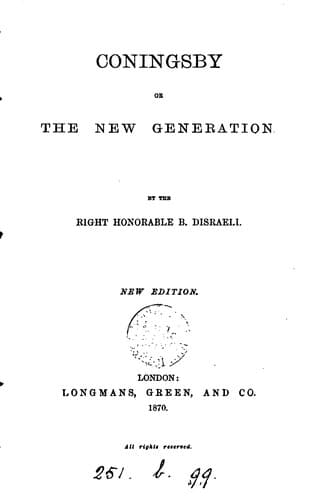
Coningsby; Or, The New GenerationDisraeli, Benjamin, Earl of Beaconsfield
General
Coningsby; Or, The New Generation
Disraeli, Benjamin, Earl of Beaconsfield
Great Britain -- Fiction; Political fiction; Politicians -- Fiction
To see Rigby baited was more amusement to Lord Monmouth even than
Montem. Lucian Gay, however, when the affair was getting troublesome,
came forward as a diversion. He sang an extemporaneous song on the
ceremony of the day, and introduced the names of all the guests at the
dinner, and of a great many other persons besides. This was capital! The
boys were in raptures, but when the singer threw forth a verse about Dr.
Keate, the applause became uproarious.
‘Good-bye, my dear Harry,’ said Lord Monmouth, when he bade his
grandson farewell. ‘I am going abroad again; I cannot remain in this
Radical-ridden country. Remember, though I am away, Monmouth House is
your home, at least so long as it belongs to me. I understand my tailor
has turned Liberal, and is going to stand for one of the metropolitan
districts, a friend of Lord Durham; perhaps I shall find him in it when
I return. I fear there are evil days for the NEW GENERATION!’
END OF BOOK I.
BOOK II.
CHAPTER I.
It was early in November, 1834, and a large shooting party was assembled
at Beaumanoir, the seat of that great nobleman, who was the father
of Henry Sydney. England is unrivalled for two things, sporting and
politics. They were combined at Beaumanoir; for the guests came not
merely to slaughter the Duke’s pheasants, but to hold council on the
prospects of the party, which it was supposed by the initiated, began at
this time to indicate some symptoms of brightening.
The success of the Reform Ministry on their first appeal to the new
constituency which they had created, had been fatally complete. But the
triumph was as destructive to the victors as to the vanquished.
‘We are too strong,’ prophetically exclaimed one of the fortunate
cabinet, which found itself supported by an inconceivable majority of
three hundred. It is to be hoped that some future publisher of private
memoirs may have preserved some of the traits of that crude and
short-lived parliament, when old Cobbett insolently thrust Sir Robert
from the prescriptive seat of the chief of opposition, and treasury
understrappers sneered at the ‘queer lot’ that had arrived from Ireland,
little foreseeing what a high bidding that ‘queer lot’ would eventually
command. Gratitude to Lord Grey was the hustings-cry at the end of 1832,
the pretext that was to return to the new-modelled House of Commons
none but men devoted to the Whig cause. The successful simulation,
like everything that is false, carried within it the seeds of its
own dissolution. Ingratitude to Lord Grey was more the fashion at the
commencement of 1834, and before the close of that eventful year, the
once popular Reform Ministry was upset, and the eagerly-sought Reformed
Parliament dissolved!
Public-domain text, read in full here on John Shaqi.
Reviews
Reviews
No reviews yet
Be the first to share your thoughts on this work.
Join the Discussion
Join the discussion
Sign in to leave a comment or review.
Sign InorCreate an account