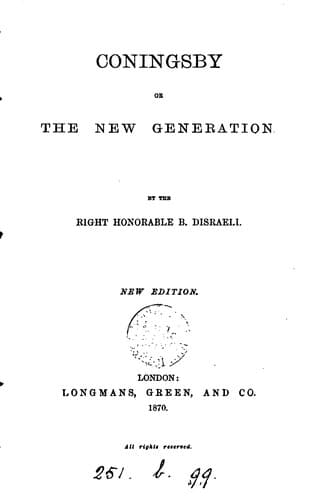
Coningsby; Or, The New GenerationDisraeli, Benjamin, Earl of Beaconsfield
General
Coningsby; Or, The New Generation
Disraeli, Benjamin, Earl of Beaconsfield
Great Britain -- Fiction; Political fiction; Politicians -- Fiction
They all left the room together; they were in the hall; the gentlemen
who brought the news looked somewhat depressed, but Mr. Rigby gay, even
amid the prostration of his party, from the consciousness that he had
most critically demolished a piece of political gossip and conveyed a
certain degree of mortification to a couple of his companions; when a
travelling carriage and four with a ducal coronet drove up to the house.
The door was thrown open, the steps dashed down, and a youthful noble
sprang from his chariot into the hall.
‘Good morning, Rigby,’ said the Duke.
‘I see your Grace well, I am sure,’ said Mr. Rigby, with a softened
manner.
‘You have heard the news, gentlemen?’ the Duke continued.
‘What news? Yes; no; that is to say, Mr. Rigby thinks--’
‘You know, of course, that Lord Lyndhurst is with the King?’
‘It is impossible,’ said Mr. Rigby.
‘I don’t think I can be mistaken,’ said the Duke, smiling.
‘I will show your Grace that it is impossible,’ said Mr. Rigby, ‘Lord
Lyndhurst slept at Wimbledon. Lord Grey could not have seen the King
until twelve o’clock; it is now five minutes to one. It is impossible,
therefore, that any message from the King could have reached Lord
Lyndhurst in time for his Lordship to be at the palace at this moment.’
‘But my authority is a high one,’ said the Duke.
‘Authority is a phrase,’ said Mr. Rigby; ‘we must look to time and
place, dates and localities, to discover the truth.’
‘Your Grace was saying that your authority--’ ventured to observe Mr.
Tadpole, emboldened by the presence of a duke, his patron, to struggle
against the despotism of a Rigby, his tyrant.
‘Was the highest,’ rejoined the Duke, smiling, ‘for it was Lord
Lyndhurst himself. I came up from Nuneham this morning, passed his
Lordship’s house in Hyde Park Place as he was getting into his carriage
in full dress, stopped my own, and learned in a breath that the Whigs
were out, and that the King had sent for the Chief Baron. So I came on
here at once.’
‘I always thought the country was sound at bottom,’ exclaimed Mr. Taper,
who, under the old system, had sneaked into the Treasury Board.
Tadpole and Taper were great friends. Neither of them ever despaired
of the Commonwealth. Even if the Reform Bill were passed, Taper was
convinced that the Whigs would never prove men of business; and when his
friends confessed among themselves that a Tory Government was for the
future impossible, Taper would remark, in a confidential whisper, that
for his part he believed before the year was over the Whigs would be
turned out by the clerks.
‘There is no doubt that there is considerable reaction,’ said Mr.
Tadpole. The infamous conduct of the Whigs in the Amersham case has
opened the public mind more than anything.’
‘Aldborough was worse,’ said Mr. Taper.
Public-domain text, read in full here on John Shaqi.
Reviews
Reviews
No reviews yet
Be the first to share your thoughts on this work.
Join the Discussion
Join the discussion
Sign in to leave a comment or review.
Sign InorCreate an account