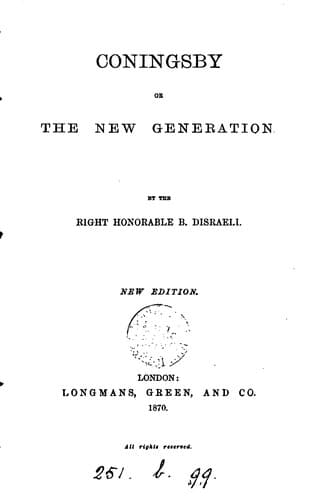
Coningsby; Or, The New GenerationDisraeli, Benjamin, Earl of Beaconsfield
General
Coningsby; Or, The New Generation
Disraeli, Benjamin, Earl of Beaconsfield
Great Britain -- Fiction; Political fiction; Politicians -- Fiction
‘Terrible,’ said Tadpole. ‘They said there was no use discussing the
Reform Bill in our House. I believe Rigby’s great speech on Aldborough
has done more towards the reaction than all the violence of the
Political Unions put together.’
‘Let us hope for the best,’ said the Duke, mildly. ‘’Tis a bold step on
the part of the Sovereign, and I am free to say I could have wished it
postponed; but we must support the King like men. What say you, Rigby?
You are silent.’
‘I am thinking how very unfortunate it was that I did not breakfast with
Lyndhurst this morning, as I was nearly doing, instead of going down to
Eton.’
‘To Eton! and why to Eton?’
‘For the sake of my young friend here, Lord Monmouth’s grandson. By the
bye, you are kinsmen. Let me present to your Grace, MR. CONINGSBY.’
CHAPTER II.
The political agitation which for a year and a half had shaken England
to its centre, received, if possible, an increase to its intensity and
virulence, when it was known, in the early part of the month of May,
1832, that the Prime Minister had tendered his resignation to the King,
which resignation had been graciously accepted.
The amendment carried by the Opposition in the House of Lords on the
evening of the 7th of May, that the enfranchising clauses of the
Reform Bill should be considered before entering into the question of
disfranchisement, was the immediate cause of this startling event. The
Lords had previously consented to the second reading of the Bill with
the view of preventing that large increase of their numbers with which
they had been long menaced; rather, indeed, by mysterious rumours than
by any official declaration; but, nevertheless, in a manner which had
carried conviction to no inconsiderable portion of the Opposition that
the threat was not without foundation.
During the progress of the Bill through the Lower House, the journals
which were looked upon as the organs of the ministry had announced with
unhesitating confidence, that Lord Grey was armed with what was then
called a ‘carte blanche’ to create any number of peers necessary to
insure its success. But public journalists who were under the control of
the ministry, and whose statements were never contradicted, were not
the sole authorities for this prevailing belief. Members of the House of
Commons, who were strong supporters of the cabinet, though not connected
with it by any official tie, had unequivocally stated in their places
that the Sovereign had not resisted the advice of his counsellors to
create peers, if such creation were required to carry into effect what
was then styled ‘the great national measure.’ In more than one instance,
ministers had been warned, that if they did not exercise that power with
prompt energy, they might deserve impeachment. And these intimations and
announcements had been made in the presence of leading members of the
Government, and had received from them, at least, the sanction of their
silence.
Public-domain text, read in full here on John Shaqi.
Reviews
Reviews
No reviews yet
Be the first to share your thoughts on this work.
Join the Discussion
Join the discussion
Sign in to leave a comment or review.
Sign InorCreate an account