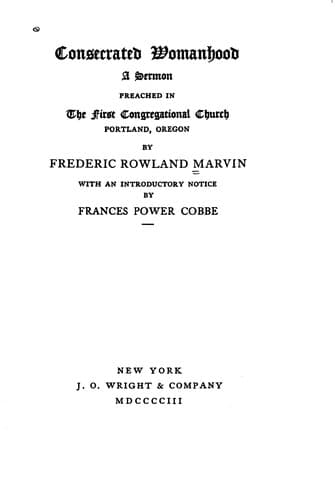
Consecrated Womanhood: A Sermon Preached in the First Congregational Church, Portland, OregonMarvin, Frederic Rowland
Religion
Consecrated Womanhood: A Sermon Preached in the First Congregational Church, Portland, Oregon
Marvin, Frederic Rowland
Sermons, American; Women -- Biblical teaching; Women in the Bible
"The might of one fair face sublimes my love,
For it hath weaned my heart from low desires;
Nor death I heed, nor purgatorial fires.
Thy beauty, antepast of joys above,
Instructs me in the bliss that saints approve;
For, oh! how good, how beautiful, must be
The God that made so good a thing as thee,
So fair an image of the heavenly dove.
Forgive me if I cannot turn away
From those sweet eyes that are my earthly heaven;
For they are guiding stars, benignly given
To tempt my footsteps to the upward way;
And if I dwell too fondly in thy sight,
I live and love in God's peculiar light."
John Stuart Mill, dedicating his immortal "Essay on Liberty" to
the memory of his beloved wife whose earthly frame he had laid to
rest beneath the shades of beautiful Avignon, described her as
"the inspirer, and in part the author, of all that was best in his
writings." The three "guardian angels" whom Comte associated with
his secret thoughts, and whom he enshrined in his innermost heart as
the sacred judges of his every wish and achievement, were his mother
Rosalie Boyer, his friend Clotilde de Vaux, and his servant Sophie
Bliot. Of Madame de Vaux he wrote six years after her death: "Adieu,
my unchangeable companion! Adieu, my holy Clotilde, who art to me at
once wife, sister, and daughter! Adieu, my dear pupil, and my fit
colleague. Thy celestial inspiration will dominate the remainder of
my life, public as well as private, and preside over my progress
towards perfection, purifying my sentiments, ennobling my thoughts, and
elevating my conduct. Perhaps, as the principal reward of the grand
tasks yet left to me to complete under thy powerful invocation, I shall
inseparably write thy name with my own, in the latest remembrances of
a grateful humanity." The Taj Mahal which the poet Heber describes as
"a dream in marble, designed by Titans and finished by jewellers,"
is a tribute of love raised over the tomb of Moomtaza Mahul by her
husband, the great Mogul, Shah Jehan. She died in giving birth to a
daughter, and her last request was that her husband would hallow in
his heart her love as the solitary and immortal sanctity of his life.
The Taj holds directly under the centre dome, "gleaming like a silver
bubble at the edge of the sky, almost as transparent in appearance
as the azure itself," the tombs of Shah Jehan and his beloved wife.
There the "married lovers" rest, encased in jasper from Punjaub,
turquoises from Thibet, agate from Yeman, garnets from Bundelkund,
and onyx, amethyst and lapis lazuli; and over them a single stone is
inscribed with the ninety-nine names of God. To this day fresh flowers
are placed upon the marble sarcophagi, and above them is to be seen
the ostrich egg, symbol of the all-encircling Divine Providence. "The
most exquisite building on the globe" is a memorial of the love a
noble and beautiful woman inspired in the heart of a devoted husband.
Public-domain text, read in full here on John Shaqi.
Reviews
Reviews
No reviews yet
Be the first to share your thoughts on this work.
Join the Discussion
Join the discussion
Sign in to leave a comment or review.
Sign InorCreate an account