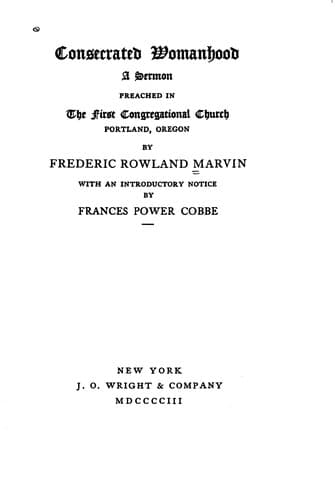
Consecrated Womanhood: A Sermon Preached in the First Congregational Church, Portland, OregonMarvin, Frederic Rowland
Religion
Consecrated Womanhood: A Sermon Preached in the First Congregational Church, Portland, Oregon
Marvin, Frederic Rowland
Sermons, American; Women -- Biblical teaching; Women in the Bible
Who shall measure the power and authority of woman in the worlds of
art, literature and social life? And yet, great as is her influence in
these, it is even greater in spiritual matters. Woman turns through a
natural instinct to the field of religious usefulness, and Renan is
not mistaken when he tells us that she has a special tendency to "long
after the infinite." Of this Frances Power Cobbe gives us a forcible
illustration in a foot-note to her able essay on "The Fitness of Women
for the Ministry of Religion." The illustration is taken from Mrs.
Kemble's autobiography, and runs as follows: "She describes the late
Lady Byron as often expressing envy of her (Mrs. Kemble's) public
readings, and her longing to have similar crowds in sympathy with her
own impressions. 'I made her laugh,' says Mrs. Kemble, 'by telling her
that more than once when looking from my reading-desk over the sea of
faces uplifted toward me, a sudden feeling had seized me that I must
say something _from myself_ to all these human beings whose attention I
felt at that moment entirely at my command, and between whom and myself
a sense of sympathy thrilled powerfully and strangely through my heart
as I looked steadfastly at them before opening my lips; but that on
wondering afterwards what I might, could, would or should have said to
them from myself, I never could think of anything but two words—'_Be
good!_'" Miss Cobbe writes: "I believe that nine women out of ten of
the better sort would, if they had the choice, oftener speak of duty
and religion than of any other theme." Is not Goëthe right?
"The eternal womanly
Draws us upward and onward."
Great is the power of consecrated womanhood in domestic life. It has
been shown by able writers that boys who have sisters, and grow up in
their society, are more likely to develop into strong and noble men
than boys who are deprived of woman's influence. Whatever separates man
from woman separates both from God. The great objection urged against
social clubs is that they destroy domestic life by isolating the sexes;
they furnish an amusement for the husband in which the wife cannot
participate. Open the social club to both sexes, and its evil tendency
is removed.
Public-domain text, read in full here on John Shaqi.
Reviews
Reviews
No reviews yet
Be the first to share your thoughts on this work.
Join the Discussion
Join the discussion
Sign in to leave a comment or review.
Sign InorCreate an account