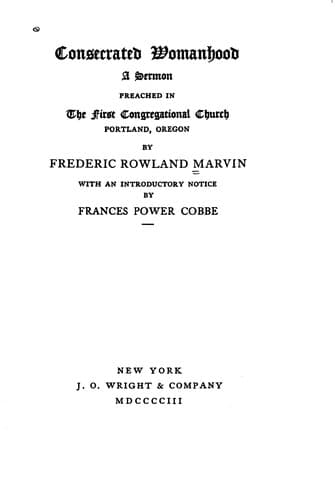
Consecrated Womanhood: A Sermon Preached in the First Congregational Church, Portland, OregonMarvin, Frederic Rowland
Religion
Consecrated Womanhood: A Sermon Preached in the First Congregational Church, Portland, Oregon
Marvin, Frederic Rowland
Sermons, American; Women -- Biblical teaching; Women in the Bible
Lord Lytton, the elegant and shallow trifler, tells us, "A woman's
noblest station is retreat," but "retreat" is a word forever unpopular
with the women of the Bible. Miriam, Huldah, Deborah and Anna were
not of Lord Lytton's opinion. They joined in one temperament silk
and steel, and added to the sweetness of womanhood the strength of
manhood. Keen and flexible as the Damascus blade, they were not wanting
in the gentleness and modesty which are a woman's crown of honor. I
open Exodus and read a song from Miriam, the prophetess, that is older
than the most ancient pagan lyric, and that will continue when English
literature is forgotten. And there is Deborah, the nurse of Rebecca;
how tenderly the Bible records her humble but faithful service. In
ancient times and in the East nurses were held in greater esteem than
now with us. Homer sang their praise; Virgil celebrated their virtues;
and Ovid extolled their wisdom and kindness. It is no trivial office to
guide and direct the development of a child's life. The nurse is second
mother, and her influence is sometimes, perhaps often, deathless as the
soul she instructs. The Bible teaches respect and consideration for
those who are socially beneath us as servants, nurses, and dependent
children of humble toil. The true lady takes her politeness into the
kitchen; it is her ability to do so that makes her the lady she is.
Not fine manners in the ball-room, but a genuine and gracious dignity
seasoned with womanly kindness, creates the true lady. Few think of the
Bible as a book of social and domestic etiquette, and yet such it is.
Let a man follow its precepts, and he shall become not only a good man,
but a _gentleman_; and whatever woman will conform to the spirit of the
Sermon on the Mount shall find her life steadily developing into all
that makes a beautiful character and fine address.
And there is the other Deborah, a prophetess and judge in Israel—the
woman divinely illuminated. I turn to the fifth chapter of Judges,
and read a song she wrote long before the gods of Greece held sacred
counsel upon snowy Olympus—centuries before the lyric muse took up her
abode beneath the shadow of the Parthenon. To what glorious victory she
led the hosts of the Lord when the enemies of Israel perished among the
"oaks of the wanderers."
"After the days of Shamgar, son of Anath,
After the Helper's days,
The highways were deserted,
The traveler went in winding ways.
Deserted were Israel's hamlets, deserted,
Till I Deborah rose up—rose up a mother in Israel."
What a lovely poem is that of Ruth, and who does not linger with
delight over the story of Esther, so royal and so simple, so queenly
and so modest?
Turn to the New Testament and see how honored is Mary, the mother of
Jesus. Hear the angelic salutation:
Public-domain text, read in full here on John Shaqi.
Reviews
Reviews
No reviews yet
Be the first to share your thoughts on this work.
Join the Discussion
Join the discussion
Sign in to leave a comment or review.
Sign InorCreate an account