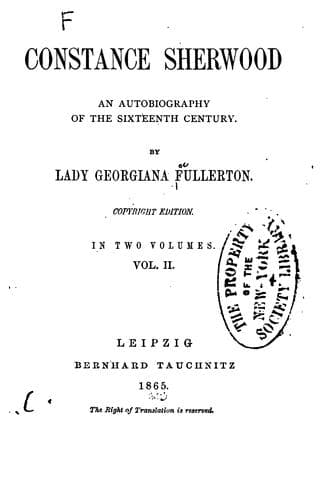
Constance Sherwood: An Autobiography of the Sixteenth CenturyFullerton, Georgiana
History
Constance Sherwood: An Autobiography of the Sixteenth Century
Fullerton, Georgiana
Great Britain -- History -- Elizabeth, 1558-1603 -- Fiction
"As a good wife, I should wish as my lord does; and indeed this
marriage, Mistress Constance, would please me well; for the Queen of
Scots is Catholic, and methinks if his grace were to wed her, there
might arise some good out of it to such as are dependent on his
grace touching matters of religion; and since Mr. Martin has gone
beyond seas, 'tis very little I hear in this house but what is
contrary to the teaching I had at my grandmother's. My lord saith
this queen's troubles will be ended if she doth marry his grace, for
so Higford has told him; but when I spoke thereof to my Lady Lumley,
she prayed God his grace's might not then begin, but charged me to
be silent thereon before my Lord Arundel, who has greatly set his
heart on this match. She said words were in every one's mouth
concerning this marriage which should never have been spoken of but
amongst a few. 'Nan,' quoth she, 'if Phil and thou do let your
children's tongues wag anent a matter which may well be one of life
and death, more harm may come of it than can well be thought of.' So
prithee, Mistress Constance, do you be silent as the grave on what I
have herein written, if so be you have not heard of it but
from me. My lord had a quarrel with my Lord Essex, who is about his
own age, anent the Queen of Scots, a few days since, when he came to
spend his birthday with him; for my lord was twelve years old last
week, and I gave him a fair jewel to set in his cap, for a
love-token and for remembrance. My lord said that the Queen of Scots
was a lady of so great virtue and beauty that none else could be
compared with her; upon which my lord of Essex cried it was high
treason to the queen's majesty to say so, and that if her grace held
so long a time in prison one who was her near kinswoman, it was by
reason of her having murthered her husband and fomented rebellion in
this kingdom of England, for the which she did deserve to be
extremely used. My lord was very wroth at this, and swore he was no
traitor, and that the Queen of Scots was no murtheress, and he would
lay down his head on the block rather than suffer any should style
her such; upon which my lord of Essex asked, 'Prithee, my Lord
Surrey, were you at Thornham last week when the queen's majesty was
on a visit to your grandfather, my Lord Arundel?' 'No,' cried my
lord, 'your lordship being there yourself in my Lord Leicester's
suite, must needs have noticed I was absent; for if I had been
present, methinks 'tis I and not your lordship would have waited
behind her majesty's chair at table and held a napkin to her.' 'And
if you had, my lord,' quoth my Lord Essex, waxing hot in his speech,
'you would have noticed how her grace's majesty gave a nip to his
grace your father, who was sitting by her side, and said she would
have him take heed on what pillow he rested his head.' 'And I would
Public-domain text, read in full here on John Shaqi.
Reviews
Reviews
No reviews yet
Be the first to share your thoughts on this work.
Join the Discussion
Join the discussion
Sign in to leave a comment or review.
Sign InorCreate an account