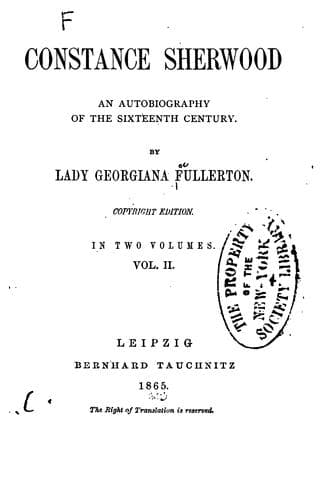
Constance Sherwood: An Autobiography of the Sixteenth CenturyFullerton, Georgiana
History
Constance Sherwood: An Autobiography of the Sixteenth Century
Fullerton, Georgiana
Great Britain -- History -- Elizabeth, 1558-1603 -- Fiction
have you take heed,' cries my lord, 'how you suffer your tongue to
wag in an unseemly manner anent her grace's majesty and his grace my
father and the Queen of Scots, who is kinswoman to both, and even
now a prisoner, which should make men careful how they speak of her
who cannot speak in her own cause; for it is a very inhuman part, my
lord, to tread on such as misfortune has cast down.' There was a
nobleness in these words such as I have often taken note of in my
lord, though so young, and which his playmate yielded to; so that
nothing more was said at that time anent those matters, which indeed
do seem too weighty to be discoursed upon by young folks. But I have
thought since on the lines which 'tis said the queen's majesty wrote
when she was herself a prisoner, which begin,
'O Fortune! how thy restless, wavering state
Hath fraught with cares my troubled wit;
Witness this present prison, whither fate
Could bear me, and the joys I quit'--
and wondered she should have no greater pity on those in the same
plight, as so many be at this time. Ah me! I would not keep a bird
in a cage an I could help it, and 'tis sad men are not more tender
of such as are of a like nature with themselves!
"My lord was away some days after this at Oxford, whither he had
been carried to be present at the queen's visit, and at the play of
_Palamon and Arcite_, which her majesty heard in the common hall of
Christ's Church. One evening, as my lady Margaret and I (like two
twin cherries on one stalk, my lord would say, for he is mightily
taken with the stage-plays he doth hear, and hath a trick of framing
his speech from them) were sitting at the window near unto the
garden practising our lutes and singing madrigals, he surprised us
with his sweet company, in which I find an ever increasing content,
and cried out as he approached, 'Ladies, I hold this sentence of the
poet as a canon of my creed, that whom God loveth not, they love not
music.' And then he said that albeit Italian was a very harmonious
and sweet language which pleasantly tickleth the ear, he for his
part loved English best, even in singing. Upon which, finding him in
the humor for discreet and sensible conversation, which,
albeit he hath good parts and a ready wit, is not always the case,
by reason of his being, as boys mostly are, prone to wagging, I took
occasion to relate what I had heard my Lord of Arundel say touching
his visit to the court of Brussels, when the Duchess of Parma
invited him to a banquet to meet the Prince of Orange and most of
the chief courtiers. The discourse was carried on in French; but my
lord, albeit he could speak well in that language, nevertheless made
use of an interpreter. At the which the Prince of Orange expressed
his surprise to Sir John Wilson, who was present, that an English
nobleman of so great birth and breeding should be ignorant of the
Public-domain text, read in full here on John Shaqi.
Reviews
Reviews
No reviews yet
Be the first to share your thoughts on this work.
Join the Discussion
Join the discussion
Sign in to leave a comment or review.
Sign InorCreate an account