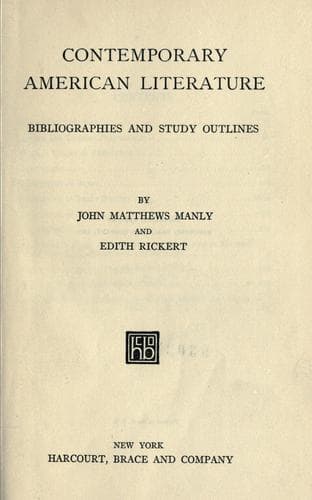
Contemporary American Literature: Bibliographies and Study OutlinesManly, John Matthews
General
Contemporary American Literature: Bibliographies and Study Outlines
Manly, John Matthews
American literature -- 20th century -- Bio-bibliography; American literature -- Outlines, syllabi, etc.
The Loves of Pelleas and Etarre. 1907.
Friendship Village. 1908.
Friendship Village Love Stories. 1909.
Mothers to Men. 1911.
When I Was a Little Girl. 1913.
Neighborhood Stories. 1914.
The Neighbors. 1914. (One-act play.)
A Daughter of the Morning. 1917.
Birth. 1918.
*Miss Lulu Bett. 1920. (Play, 1921.)
The Secret Way. 1921. (Poems.)
STUDIES AND REVIEWS
Acad. 75 ('08): 595.
Bookm. 13 ('01): 520 (portrait); 25 ('07): 567 (portrait);
53 ('21): 123.
See also _Book Review Digest_, 1915, 1917-19, 1920.
+Hamlin Garland+--short-story writer, novelist.
Born on a farm near West Salem, Wisconsin, 1860, of Scotch and New
England ancestry. During his boyhood, his father moved first to Iowa,
then to Dakota. As a boy, Mr. Garland helped his father with all the hard
work of making farmland out of prairie. While still in his teens, he was
able to do a man's work. His schooling was desultory, but he finished the
course at Cedar Valley Seminary, Osage, Iowa, then taught, 1882-3. In
1883 he took up a claim in Dakota, but the next year went to Boston and
began his career as teacher and writer.
SUGGESTIONS FOR READING
1. Read the autobiographical books, _A Son of the Middle Border_ and _A
Daughter of the Middle Border_, to get the background of Mr. Garland's
work. Then read his essays called _Crumbling Idols_, for the literary
theory on which his work was created.
2. Two literary landmarks in Mr. Garland's history are: Edward
Eggleston's _The Hoosier Schoolmaster_ (1871), and Joseph Kirkland's
_Zury: the Meanest Man in Spring County_ (1887). Read these and decide
how much they influenced _Main-Traveled Roads_ and similar volumes of Mr.
Garland's.
3. Mr. Garland says that he presents farm life "not as the summer boarder
or the young lady novelist sees it--but as the working farmer endures
it." Find evidence of this.
4. Consider how far Mr. Garland's success depends upon the richness of
his material, how far upon his philosophy of life and his honesty to his
own experience, and how far upon his technical skill as a writer.
5. What are his most obvious limitations? What is the relative importance
of his novels and of his short stories?
6. Consider separately: (1) his power of visualization; (2) his choice of
significant detail; (3) his originality or lack of it; (4) his range in
characterization; (5) his power of suggestion as over against his
vividness of delineation; (6) his economy--or lack of it--in expression.
Where does his main strength lie?
BIBLIOGRAPHY
Public-domain text, read in full here on John Shaqi.
Reviews
Reviews
No reviews yet
Be the first to share your thoughts on this work.
Join the Discussion
Join the discussion
Sign in to leave a comment or review.
Sign InorCreate an account