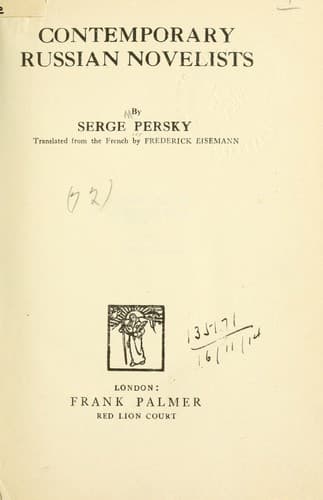
Novelists, Russian; Russian fiction -- History and criticism
This truth burst forth in all its strength about 1870, the time of
the great reforms undertaken by Alexander II, when the interests of
the people were, for the first time, the order of the day. It was
at this period that a great deal of studying was being done with
great enthusiasm and that a general infatuation for folklore and for
a "union with the masses" was being shown. The desire to become
"simplified," that is to say to have all people live the same kind
of life, the appearance of a type, celebrated under the sarcastic
name of "noble penitent" (meaning the titled man who is ashamed of
his privileged position as if it were a humiliating and infamous
thing), the politico-socialistic ideology of the first Slavophiles,
still half conservative, but wholly democratic; all these things
were the results of the manifestations which astonished Rostopchin
and made the more intelligent class of Russians fraternize more with
the masses. In our day, this tendency has been eloquently
illustrated by the greatest Russian artist and thinker, Tolstoy, who
was the very incarnation of the ideas named above, and who always
appears to us as a highly cultured peasant. The hero of
"Resurrection" sums up in a few words this sympathy for the people:
"This is it, the big world, the true world!" he says, on seeing the
crowd of peasants and workingmen packed into a third-class
compartment.
In the last half of the 19th century, Russian literature took a
further step in the way of democracy. It passed from the hands of
the nobility into the hands of the middle class, as the conditions
under which it existed brought it closer to the people and made it
therefore more accessible to their aspirations. It is no longer the
great humanitarians of the privileged class who paint the miserable
conditions among which people vegetate; it is the people themselves
who are beginning to speak of their miseries and of their hopes for
a better life. The result is a deep penetration of the popular mind,
in conjunction with an acute, and sometimes sickly, nervousness,
which is shown in the works of the great Uspensky, and, more
recently still, in Tchekoff, Andreyev, and many others.
None of these writers belong to the aristocracy, and two of
them--Tchekoff and Gorky--have come up from the masses: the former
was the son of a serf, and the latter the son of a workingman. Let
me add that, among the women of letters, the one who is most
distinguished by her talent in describing scenes from popular
life--Mme. Dmitrieva--is the daughter of a peasant woman.
Public-domain text, read in full here on John Shaqi.
Reviews
Reviews
No reviews yet
Be the first to share your thoughts on this work.
Join the Discussion
Join the discussion
Sign in to leave a comment or review.
Sign InorCreate an account