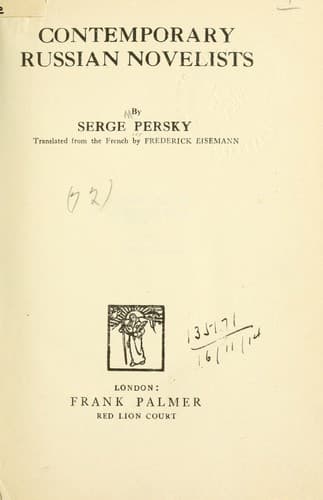
Novelists, Russian; Russian fiction -- History and criticism
There was a time in Europe when they christened with the name
"nihilism" this active negation of civilization and of bourgeois
customs, so characteristic of the Russian "intellectuals." Taken in
its literal sense, this word is inexact, since those to whom it was
applied were inspired by a very high ideal. In a loose use of the
word, nihilism has, on the contrary, a real significance, especially
if one connects it with most of the Russian "intellectuals." The
liberal tendencies which were brewing in the realistic literature of
the period from 1840 to 1850, and which manifested themselves
suddenly with particular strength during the tumultuous decade
between 1860 and 1870, made the substance of the new theories and
the base of Russian mentality. These theories were very bold in
their negation, and it is for this reason that they have been called
"nihilistic."
If this intellectual "elite" should some day triumph in Russia, will
it be true to its moral idea of justice and liberty? It probably
will. We may then see the following phenomenon take place: the
realization of the most advanced program of modern civilization in
one of the most backward countries of Europe.
However paradoxical such a prevision may seem at first, it has a
fundamental element of truth. Two obstacles bar the way to
civilization and the normal development of new ideas, which are the
foundation of progress. First of all, there is the naive and boorish
ignorance of the common people; then the resistance which every
established society instinctively offers to ideas of reformation. Of
these two conservative forces, Russia knows but one, pure and simple
ignorance, while the second, which can have art and science as
powerful allies, is completely lacking. But ignorance cannot last
forever. It diminishes more and more; that is why the most advanced
ideas of European civilization naturally go hand in hand with
learning in Russia, and occupy all places which knowledge wins from
ignorance. Since the Russian has had a taste of science he has
become the champion of social and democratic ideas; the latter
develop even with elementary instruction, as can easily be seen by
observing the movements made among the workmen of the city, and also
among the more advanced elements of the peasant population.
These particulars had already attracted the attention of the
brilliant peace advocate and profound thinker, Hertzen, who,
distressed by the bloody reprisals of bourgeoise Europe, following
the Revolution of 1848, fixed his attention on Russia, from which he
expected great things,--among others, a new civilization freed from
the prejudices and customs which held it back in other countries.
Public-domain text, read in full here on John Shaqi.
Reviews
Reviews
No reviews yet
Be the first to share your thoughts on this work.
Join the Discussion
Join the discussion
Sign in to leave a comment or review.
Sign InorCreate an account