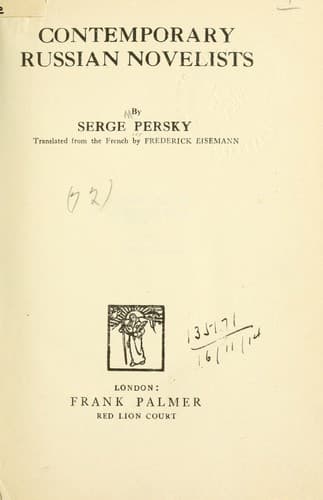
Novelists, Russian; Russian fiction -- History and criticism
Hertzen represented Russia as an immense plain where people were
getting rid of old thatched cottages, and at the same time
collecting the necessary materials for new habitations. He saw a
world in which no one lived as yet, but where life as it should be
was being prepared for. And this idea, which may seem exaggerated,
has a good deal of sense in it. Does not every backward nation,
which hastens to take her place in the circle of the more advanced
peoples of Europe, resemble a vessel into which a new wine is to be
poured?
* * * * *
If modern Russian literature has not deviated from its fundamental
principles, realism, democracy, and socialism, on the other hand, a
radical change has taken place in society which has necessarily had
an influence on it. The populace is not the sombre, inert, and
ignorant multitude that it has been heretofore. Learning is
penetrating more and more; and as an advance-guard, it has the
workingmen of the city and the people of the suburbs. A feeling of
dignity, of human personality, and a love of liberty is awakening in
the masses who have joined in the struggle which the "intellectuals"
are conducting against the passive forces of autocracy.
That is why the literature of this time--always excepting the period
from 1905 to 1910--is preeminently a literature of fiercer and more
active combat than ever before. As in times gone by, the heroes of
this literature are common people. The writers choose them from
among the students, schoolmasters, and school-mistresses of the
village schools, who with complete disregard of self carry on the
great work of popular education in the very heart of the country,
without caring about the arbitrary power which menaces them, or the
moral and material conditions of their lives. They also choose them
from among the doctors of the districts who are worn out in
despairing efforts to struggle against the terrible epidemics, and
who are also trying to improve hygienic conditions among the
peasants. In fine, among the heroes are included all who sacrifice
their personal interests for the general good.
The results of this terrible struggle against brute force are shown
in the excessive nervousness of the combatants, who have become
delirious with their aspirations towards liberty. Hatred of actual
reality and distrust of those who have resigned themselves to it
have made them accept sympathetically the most extreme and
uncompromising measures, and one often thinks one sees a certain
generosity among the people who are at war with society,--often, it
is true, for egotistical reasons, far removed from the great ideal
of reforms profitable to the masses. Such are the celebrated
barefoot brigade, the eternal vagabonds, the "lumpen-proletariat" of
Gorky's early works.
Public-domain text, read in full here on John Shaqi.
Reviews
Reviews
No reviews yet
Be the first to share your thoughts on this work.
Join the Discussion
Join the discussion
Sign in to leave a comment or review.
Sign InorCreate an account