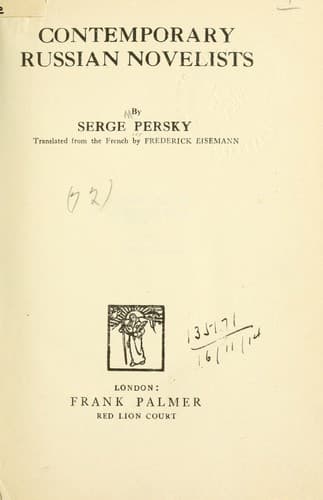
Novelists, Russian; Russian fiction -- History and criticism
The unhealthy ravine hides a village inhabited by factory workers.
The best house belongs to Gregory Tzibukine, who traffics in
everything: brandy, wheat, cattle, lumber, and usury, on the side.
His eldest son, Anissme, is employed at the police station and
seldom comes home; the second son, Stepan, is deaf and sickly; he
helps his father both well and badly, and his wife, the pretty and
coquettish Axinia, runs all day between the cellar and the shop. The
father Tzibukine is also friendly to her and respects this young
woman, for she is a very good worker and is most intelligent.
Tzibukine, a widower, has married Varvara, an affable and pious soul
who gives alms,--a strange thing in this family who cheat everybody.
Anissme often sends home beautiful letters and presents. One day, he
comes unexpectedly; he has an unquiet, and, at the same time,
flippant air. His parents have decided to get him married, and,
although he is a drunkard, ugly and vulgar, they have found him a
pretty wife. The girl is Lipa, daughter of a poor widow, a laborer
like her mother. Anissme whistles and looks at the ceiling, and
shows no signs of pleasure at his coming marriage. He leaves the
house in a strange manner, and appears again three days before the
wedding, bringing to his parents, as gifts, some newly coined money.
The wedding day has come. The clergy and the well-to-do of the
neighborhood are present at the dinner, which is sumptuously served.
Lipa seems petrified with fear, for she barely knows her husband.
The festivities last a long time; at intervals the voices of women
can be heard outside hurling curses at the usurer. Then Anissme,
red, drunk, and sweating, is shoved into the room where Lipa has
already disrobed. Five days later, Anissme comes to his mother and
bids her good-bye. He confides in her that some one has given him
advice, and that he has decided either to become rich or to perish.
Now that her husband has departed, Lipa again becomes gay.
Public-domain text, read in full here on John Shaqi.
Reviews
Reviews
No reviews yet
Be the first to share your thoughts on this work.
Join the Discussion
Join the discussion
Sign in to leave a comment or review.
Sign InorCreate an account