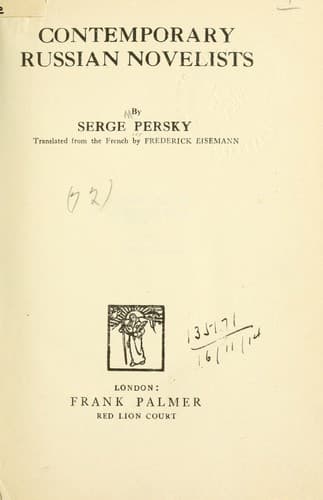
Novelists, Russian; Russian fiction -- History and criticism
Meanwhile, they have arrested a reaper accused of having circulated
a bad piece of money which he says he received from Anissme the
night of the wedding. Tzibukine goes home, examines the money that
his son has given him, and decides that it is all counterfeit. He
orders Axinia to throw every bit of it into the well. But, instead
of obeying, she pays it out as wages to the workmen. A week passes;
they find out that Anissme has been thrown into prison as a
counterfeiter. Tzibukine despairs; he feels his strength
diminishing. Varvara continues to pray and to watch, while Stepan
and Axinia continue to ply their trade as before. When, later on,
Anissme is sentenced to ten years at hard labor in Siberia, Varvara
suggests to her husband that he should leave one of his houses to
the child which has just been born to Lipa, so that no one will
speak badly of him after his death. But, at this suggestion, Axinia
flies into such a fury, that, in her homicidal rage, she throws a
kettle of boiling water over the child, who dies later at the
hospital. Finally, she drives the young woman out of the house. Lipa
returns to her mother. Soon Axinia reigns as absolute mistress of
the house. Tzibukine becomes distracted; he does not take care of
his money any more, because he cannot tell the good from the bad.
Rumor has it that his daughter-in-law is letting him die of hunger.
Varvara still goes on with her good work. Anissme is forgotten. The
old man, starving, and driven from home, lodges a complaint against
the young woman. Coming back to the village, the old man, tottering
along the street, meets Lipa and her mother, who are now doing tile
work.
"Both bow deeply to him, and he looks at them with tears in his
eyes. Lipa offers him a piece of oatmeal cake, and the two women go
on their way, crossing themselves several times...."
The virtuous Varvara is an extremely characteristic type, with a
subtle psychology, carefully worked out; her honesty and goodness
form an indispensable contrast to the ambient horrors.
The author himself explains the role of Varvara and her action in
this system of evil. "Her alms seem to be something strange, joyous
and free, like the red flowers and the lights that glow before the
saintly images." On holidays, and on jubilees, which last three
days, when coarse and rotten meat is sold to the peasants who come
to pawn their scythes and hats, or their wives' shawls; when the
workingmen lie in the gutter under the influence of bad brandy, then
"one feels a bit relieved at the thought that down there, in that
house, there is a good and quiet woman, always ready to help
unfortunates."
Lipa and her mother are good and timid souls who suffer in silence,
and give to the poor the little that they possess:
Public-domain text, read in full here on John Shaqi.
Reviews
Reviews
No reviews yet
Be the first to share your thoughts on this work.
Join the Discussion
Join the discussion
Sign in to leave a comment or review.
Sign InorCreate an account