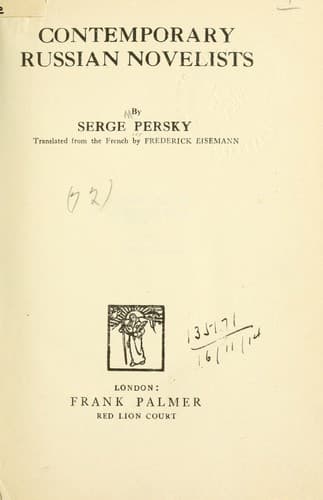
Novelists, Russian; Russian fiction -- History and criticism
[4] For some reason, unknown to the translator, the author has
made no mention of Tchekoff's famous play, "The Sea-Gull." This
drama, which, when first produced, was a flat failure, scored a
tremendous success a short while afterwards. It is especially
interesting in that the author has made one of the characters,
Trigorin, largely autobiographical. To-day "The Sea-Gull" is one
of the most popular productions on the Russian stage.
They are now thrown out into the world. The old existence has gone,
as well as the seignioral estate. The Cherry Garden is to be torn
down; the blinds are all lowered, and in the half-darkened rooms,
the old servant, who is nearly a century old, wanders about among
the disordered furniture.
* * * * *
Tchekoff is a true product of Russian literature, an autochthon
plant, nourished by his natal sap. His humor is completely Russian;
we hear Tolstoyan notes in his democracy; the "failures" of his
stories are distantly related to the "superficial characters" of
Turgenev; finally, the theory of the redemption of the past by
suffering which he puts in the heart of the hero of the "Cherry
Garden" makes us think of Dostoyevsky. The qualities which call to
mind all these great names in Russian literature are found in the
works of Tchekoff along with characteristics which show a very
original talent. If one wishes to look for foreign influence, one
can relate Tchekoff to de Maupassant and Ibsen, of whom he reminds
one in snatches, although still in a very vague way. And that is
indeed fortunate, for, in general, Scandinavian symbolism hardly
goes hand in hand with the Russian spirit, which likes to make
_direct_ answers to "cursed questions," and whose ideal, elaborated
since 1840 in the realm of strict realism, is so definite that it
does not necessitate going back to the circumlocutions of metaphors
and allegories.
While Tchekoff lived his literary aspect was enigmatical. Some
judged him to be indifferent, because they did not find in his
writings that revolutionary spirit which is felt in almost all
modern writers. Others thought of him as a pessimist who saw nothing
good in Russian life, because he described principally resigned
suffering or useless striving for a better life. Since the death of
Tchekoff, which made it necessary for the critics to study his works
as a whole, and especially since the publication of his
correspondence, his character has come to the fore, as it really is:
he is a writer, who, by the very nature of his talent, was
irresistibly forced to study the inner life of man impartially, and
who, consequently, remains the enemy of all religious or
philosophical dogmas which may hinder the task of the observer.
The division of men into good and bad, according to the point of
view of this or that doctrine, angered him:
Public-domain text, read in full here on John Shaqi.
Reviews
Reviews
No reviews yet
Be the first to share your thoughts on this work.
Join the Discussion
Join the discussion
Sign in to leave a comment or review.
Sign InorCreate an account