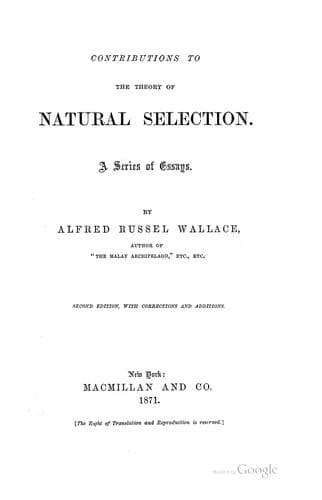
Contributions to the Theory of Natural Selection: A Series of EssaysWallace, Alfred Russel
Science
Contributions to the Theory of Natural Selection: A Series of Essays
Wallace, Alfred Russel
Natural selection
An examination of the relations of the species of the adjacent islands,
will thus enable us to correct opinions formed from a mere consideration
of their relative positions. For example, looking at a map of the
archipelago, it is almost impossible to avoid the idea that Java and
Sumatra have been recently united; their present proximity is so great,
and they have such an obvious resemblance in their volcanic structure.
Yet there can be little doubt that this opinion is erroneous, and that
Sumatra has had a more recent and more intimate connexion with Borneo
than it has had with Java. This is strikingly shown by the mammals of
these islands--very few of the species of Java and Sumatra being
identical, while a considerable number are common to Sumatra and Borneo.
The birds show a somewhat similar relationship; and we shall find that
the distribution of the Papilionidae tells exactly the same tale. Thus:--
Sumatra has 21 species }
Borneo " 30 " } 20 sp. common to both islands;
Sumatra " 21 " }
Java " 28 " } 11 sp. common to both islands;
Borneo " 30 " }
Java " 28 " } 20 sp. common to both islands;
showing that both Sumatra and Java have a much closer relationship to
Borneo than they have to each other--a most singular and interesting
result, when we consider the wide separation of Borneo from them both,
and its very different structure. The evidence furnished by a single
group of insects would have had but little weight on a point of such
magnitude if standing alone; but coming as it does to confirm deductions
drawn from whole classes of the higher animals, it must be admitted to
have considerable value.
We may determine in a similar manner the relations of the different
Papuan Islands to New Guinea. Of thirteen species of Papilionidae
obtained in the Aru Islands, six were also found in New Guinea, and
seven not. Of nine species obtained at Waigiou, six were New Guinea, and
three not. The five species found at Mysol were all New Guinea species.
Mysol, therefore, has closer relations to New Guinea than the other
islands; and this is corroborated by the distribution of the birds, of
which I will only now give one instance. The Paradise Bird found in
Mysol is the common New Guinea species, while the Aru Islands and
Waigiou have each a species peculiar to themselves.
The large island of Borneo, which contains more species of Papilionidae
than any other in the archipelago, has nevertheless only three peculiar
to itself; and it is quite possible, and even probable, that one of
these may be found in Sumatra or Java. The last-named island has also
three species peculiar to it; Sumatra has not one, and the peninsula of
Malacca only two. The identity of species is even greater than in birds
or in most other groups of insects, and points very strongly to a recent
connexion of the whole with each other and the continent.
_Remarkable Peculiarities of the Island of Celebes._
Public-domain text, read in full here on John Shaqi.
Reviews
Reviews
No reviews yet
Be the first to share your thoughts on this work.
Elsewhere in the archive
Join the Discussion
Join the discussion
Sign in to leave a comment or review.
Sign InorCreate an account