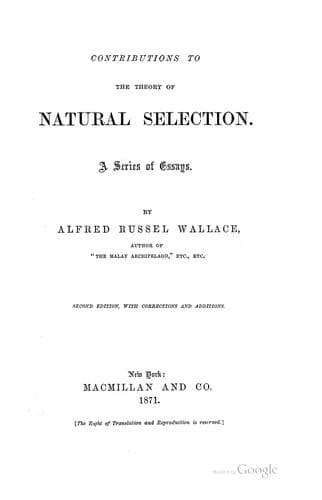
Contributions to the Theory of Natural Selection: A Series of EssaysWallace, Alfred Russel
Science
Contributions to the Theory of Natural Selection: A Series of Essays
Wallace, Alfred Russel
Natural selection
The great uniformity in the architecture of each species of bird which
has been supposed to prove a nest-building instinct, we may, therefore,
fairly impute to the uniformity of the conditions under which each
species lives. Their range is often very limited, and they very seldom
permanently change their country, so as to be placed in new conditions.
When, however, new conditions do occur, they take advantage of them just
as freely and wisely as man could do. The chimney and house-swallows are
a standing proof of a change of habit since chimneys and houses were
built, and in America this change has taken place within about three
hundred years. Thread and worsted are now used in many nests instead of
wool and horsehair, and the jackdaw shows an affection for the church
steeple which can hardly be explained by instinct. In the more thickly
populated parts of the United States, the Baltimore oriole uses all
sorts of pieces of string, skeins of silk, or the gardener's bass, to
weave into its fine pensile nest, instead of the single hairs and
vegetable fibres it has painfully to seek in wilder regions; and Wilson,
a most careful observer, believes that it improves in nest-building by
practice--the older birds making the best nests. The purple martin takes
possession of empty gourds or small boxes, stuck up for its reception in
almost every village and farm in America; and several of the American
wrens will also build in cigar boxes, with a small hole cut in them, if
placed in a suitable situation. The orchard oriole of the United States
offers us an excellent example of a bird which modifies its nest
according to circumstances. When built among firm and stiff branches the
nest is very shallow, but if, as is often the case, it is suspended from
the slender twigs of the weeping willow, it is made much deeper, so that
when swayed about violently by the wind the young may not tumble out. It
has been observed also, that the nests built in the warm Southern States
are much slighter and more porous in texture than those in the colder
regions of the north. Our own house-sparrow equally well adapts himself
to circumstances. When he builds in trees, as he, no doubt, always did
originally, he constructs a well-made domed nest, perfectly fitted to
protect his young ones; but when he can find a convenient hole in a
building or among thatch, or in any well-sheltered place, he takes much
less trouble, and forms a very loosely-built nest.
Public-domain text, read in full here on John Shaqi.
Reviews
Reviews
No reviews yet
Be the first to share your thoughts on this work.
Elsewhere in the archive
Join the Discussion
Join the discussion
Sign in to leave a comment or review.
Sign InorCreate an account