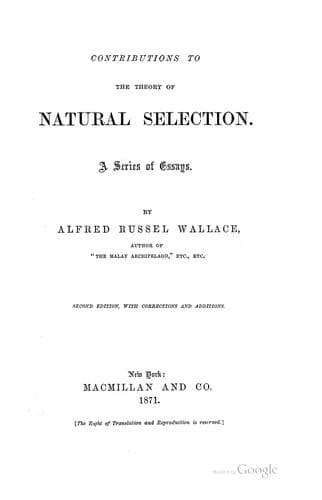
Contributions to the Theory of Natural Selection: A Series of EssaysWallace, Alfred Russel
Science
Contributions to the Theory of Natural Selection: A Series of Essays
Wallace, Alfred Russel
Natural selection
4. Trogons (Trogonidae). In these magnificent birds the females are
generally less brightly coloured than the males, but are yet often gay
and conspicuous. The nest is in a hole of a tree.
5. Hoopoes (Upupidae). The barred plumage and long crests of these birds
render them conspicuous. The sexes are exactly alike, and the nest is in
a hollow tree.
6. Hornbills (Bucerotidae). These large birds have enormous coloured
bills, which are generally quite as well coloured and conspicuous in the
females. Their nests are always in hollow trees, where the female is
entirely concealed.
7. Barbets (Capitonidae). These birds are all very gaily-coloured, and,
what is remarkable, the most brilliant patches of colour are disposed
about the head and neck, and are very conspicuous. The sexes are
exactly alike, and the nest is in a hole of a tree.
8. Toucans (Rhamphastidae). These fine birds are coloured in the most
conspicuous parts of their body, especially on the large bill, and on
the upper and lower tail coverts, which are crimson, white, or yellow.
The sexes are exactly alike, and they always build in a hollow tree.
9. Plaintain-eaters (Musophagidae). Here again the head and bill are most
brilliantly coloured in both sexes, and the nest is in a hole of a tree.
10. Ground cuckoos (Centropus). These birds are often of conspicuous
colours, and are alike in both sexes. They build a domed nest.
11. Woodpeckers (Picidae). In this family the females often differ from
the males, in having a yellow or white, instead of a crimson crest, but
are almost as conspicuous. They all nest in holes in trees.
12. Parrots (Psittaci). In this great tribe, adorned with the most
brilliant and varied colours, the rule is, that the sexes are precisely
alike, and this is the case in the most gorgeous families, the lories,
the cockatoos, and the macaws; but in some there is a sexual difference
of colour to a slight extent. All build in holes, mostly in trees, but
sometimes in the ground, or in white ants' nests. In the single case in
which the nest is exposed, that of the Australian ground parrot,
Pezoporus formosus, the bird has lost the gay colouring of its allies,
and is clothed in sombre and completely protective tints of dusky green
and black.
13. Gapers (Eurylaemidae). In these beautiful Eastern birds, somewhat
allied to the American chatterers, the sexes are exactly alike, and are
adorned with the most gay and conspicuous markings. The nest is a woven
structure, _covered over_, and suspended from the extremities of
branches over water.
14. Pardalotus (Ampelidae). In these Australian birds the females differ
from the males, but are often very conspicuous, having brightly-spotted
heads. Their nests are sometimes dome-shaped, sometimes in holes of
trees, or in burrows in the ground.
Public-domain text, read in full here on John Shaqi.
Reviews
Reviews
No reviews yet
Be the first to share your thoughts on this work.
Elsewhere in the archive
Join the Discussion
Join the discussion
Sign in to leave a comment or review.
Sign InorCreate an account