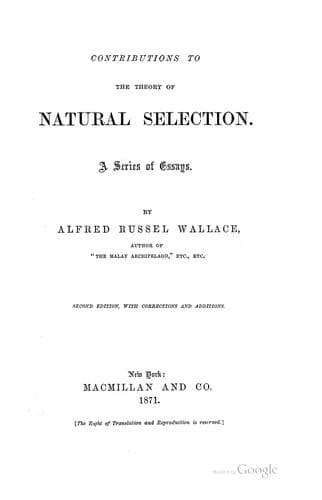
Contributions to the Theory of Natural Selection: A Series of EssaysWallace, Alfred Russel
Science
Contributions to the Theory of Natural Selection: A Series of Essays
Wallace, Alfred Russel
Natural selection
15. Tits (Paridae). These little birds are always pretty, and many
(especially among the Indian species) are very conspicuous. They always
have the sexes alike, a circumstance very unusual among the smaller
gaily-coloured birds of our own country. The nest is always covered over
or concealed in a hole.
16. Nuthatches (Sitta). Often very pretty birds, the sexes alike, and
the nest in a hole.
17.---- (Sittella). The female of these Australian nuthatches is often
the most conspicuous, being white-and black-marked. The nest is,
according to Gould, "completely concealed among upright twigs connected
together."
18. Creepers (Climacteris). In these Australian creepers the sexes are
alike, or the female most conspicuous, and the nest is in a hole of a
tree.
19. Estrelda, Amadina. In these genera of Eastern and Australian finches
the females, although more or less different from the males, are still
very conspicuous having a red rump, or being white spotted. They differ
from most others of the family in building domed nests.
20. Certhiola. In these pretty little American creepers the sexes are
alike, and they build a domed nest.
21. Mynahs (Sturnidae). These showy Eastern starlings have the sexes
exactly alike. They build in holes of trees.
22. Calornis (Sturnidae). These brilliant metallic starlings have no
sexual differences. They build a pensile covered nest.
23. Hangnests (Icteridae). The red or yellow and black plumage of most of
these birds is very conspicuous, and is exactly alike in both sexes.
They are celebrated for their fine purse-shaped pensile nests.
It will be seen that this list comprehends six important families of
Fissirostres, four of Scansores, the Psittaci, and several genera, with
three entire families of Passeres, comprising about twelve hundred
species, or about one-seventh of all known birds.
* * * * *
The cases in which, whenever the male is gaily coloured, the female is
much less gay or quite inconspicuous, are exceedingly numerous,
comprising, in fact, almost all the bright-coloured Passeres, except
those enumerated in the preceding class. The following are the most
remarkable:--
1. Chatterers (Cotingidae). These comprise some of the most gorgeous
birds in the world, vivid blues, rich purples, and bright reds, being
the most characteristic colours. The females are always obscurely
tinted, and are often of a greenish hue, not easily visible among the
foliage.
2. Manakins (Pipridae). These elegant birds, whose caps or crests are of
the most brilliant colours, are usually of a sombre green in the female
sex.
3. Tanagers (Tanagridae). These rival the chatterers in the brilliancy of
their colours, and are even more varied. The females are generally of
plain and sombre hues, and always less conspicuous than the males.
Public-domain text, read in full here on John Shaqi.
Reviews
Reviews
No reviews yet
Be the first to share your thoughts on this work.
Elsewhere in the archive
Join the Discussion
Join the discussion
Sign in to leave a comment or review.
Sign InorCreate an account