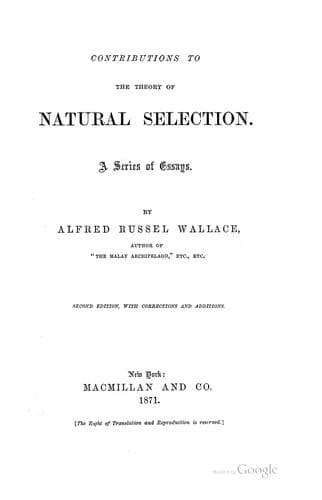
Contributions to the Theory of Natural Selection: A Series of EssaysWallace, Alfred Russel
Science
Contributions to the Theory of Natural Selection: A Series of Essays
Wallace, Alfred Russel
Natural selection
In the extensive families of the warblers (Sylviadae), thrushes
(Turdidae), flycatchers (Muscicapidae), and shrikes (Laniadae), a
considerable proportion of the species are beautifully marked with gay
and conspicuous tints, as is also the case in the Pheasants and Grouse;
but in every case the females are less gay, and are most frequently of
the very plainest and least conspicuous hues. Now, throughout _the whole
of these families the nest is open_, and I am not aware of a single
instance in which any one of these birds builds a _domed nest_, or
places it in a _hole of a tree_, or _underground_, or in any place where
it is effectually concealed.
In considering the question we are now investigating, it is not
necessary to take into account the larger and more powerful birds,
because these seldom depend much on concealment to secure their safety.
In the raptorial birds bright colours are as a rule absent; and their
structure and habits are such as not to require any special protection
for the female. The larger waders are sometimes very brightly coloured
in both sexes; but they are probably little subject to the attacks of
enemies, since the scarlet ibis, the most conspicuous of birds, exists
in immense quantities in South America. In game birds and water-fowl,
however, the females are often very plainly coloured, when the males are
adorned with brilliant hues; and the abnormal family of the Megapodidae
offers us the interesting fact of an identity in the colours of the
sexes (which in Megacephalon and Talegalla are somewhat conspicuous), in
conjunction with the habit of not sitting on the eggs at all.
_What the Facts Teach us._
Taking the whole body of evidence here brought forward, embracing as it
does almost every group of bright-coloured birds, it will, I think, be
admitted that the relation between the two series of facts in the
colouring and nidification of birds has been sufficiently established.
There are, it is true, a few apparent and some real exceptions, which I
shall consider presently; but they are too few and unimportant to weigh
much against the mass of evidence on the other side, and may for the
present be neglected. Let us then consider what we are to do with this
unexpected set of correspondences between groups of phenomena which, at
first sight, appear so disconnected. Do they fall in with any other
groups of natural phenomena? Do they teach us anything of the way in
which nature works, and give us any insight into the causes which have
brought about the marvellous variety, and beauty, and harmony of living
things? I believe we can answer these questions in the affirmative; and
I may mention, as a sufficient proof that these are not isolated facts,
that I was first led to see their relation to each other by the study of
an analogous though distinct set of phenomena among insects, that of
protective resemblance and "mimicry."
Public-domain text, read in full here on John Shaqi.
Reviews
Reviews
No reviews yet
Be the first to share your thoughts on this work.
Elsewhere in the archive
Join the Discussion
Join the discussion
Sign in to leave a comment or review.
Sign InorCreate an account