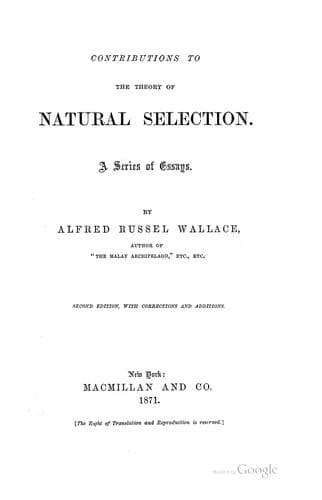
Contributions to the Theory of Natural Selection: A Series of EssaysWallace, Alfred Russel
Science
Contributions to the Theory of Natural Selection: A Series of Essays
Wallace, Alfred Russel
Natural selection
On considering this remarkable series of corresponding facts, the first
thing we are taught by them seems to be, that there is no incapacity in
the female sex among birds, to receive the same bright hues and strongly
contrasted tints with which their partners are so often decorated, since
whenever they are _protected and concealed_ during the period of
incubation _they are similarly adorned_. The fair inference is, that it
is chiefly due to the absence of protection or concealment during this
important epoch, that gay and conspicuous tints are withheld or left
undeveloped. The mode in which this has been effected is very
intelligible, if we admit the action of natural and sexual selection. It
would appear from the numerous cases in which both sexes are adorned
with equally brilliant colours (while both sexes are rarely armed with
equally developed offensive and defensive weapons when not required for
individual safety), that the normal action of "sexual selection" is to
develop colour and beauty in both sexes, by the preservation and
multiplication of all varieties of colour in either sex which are
pleasing to the other. Several very close observers of the habits of
animals have assured me, that male birds and quadrupeds do often take
very strong likes and dislikes to individual females, and we can hardly
believe that the one sex (the female) can have a general taste for
colour while the other has no such taste. However this may be, the fact
remains, that in a vast number of cases the female acquires as brilliant
and as varied colours as the male, and therefore most probably acquires
them in the same way as the male does; that is, either because the
colour is useful to it, or is correlated with some useful variation, or
is pleasing to the other sex. The only remaining supposition is that it
is transmitted from the other sex, without being of any use. From the
number of examples above adduced of bright colours in the female, this
would imply that colour-characters acquired by one sex are generally
(but not necessarily) transmitted to the other. If this be the case it
will, I think, enable us to explain the phenomena, even if we do not
admit that the male bird is ever influenced in the choice of a mate by
her more gay or perfect plumage.
The female bird, while sitting on her eggs in an uncovered nest, is much
exposed to the attacks of enemies, and any modification of colour which
rendered her more conspicuous would often lead to her destruction and
that of her offspring. All variations of colour in this direction in the
female, would therefore sooner or later be eliminated, while such
modifications as rendered her inconspicuous, by assimilating her to
surrounding objects, as the earth or the foliage, would, on the whole,
survive the longest, and thus lead to the attainment of those brown or
green and inconspicuous tints, which form the colouring (of the upper
surface at least), of the vast majority of female birds which sit upon
open nests.
Public-domain text, read in full here on John Shaqi.
Reviews
Reviews
No reviews yet
Be the first to share your thoughts on this work.
Elsewhere in the archive
Join the Discussion
Join the discussion
Sign in to leave a comment or review.
Sign InorCreate an account