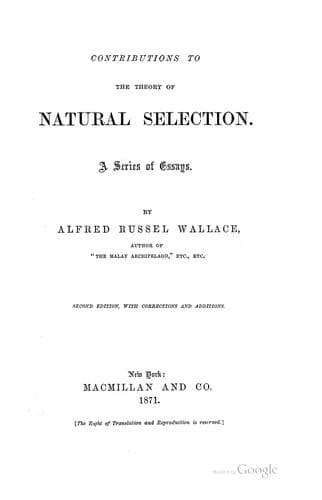
Contributions to the Theory of Natural Selection: A Series of EssaysWallace, Alfred Russel
Science
Contributions to the Theory of Natural Selection: A Series of Essays
Wallace, Alfred Russel
Natural selection
This does not imply, as some have thought, that all female birds were
once as brilliant as the males. The change has been a very gradual one,
generally dating from the origin of genera or of larger groups, but
there can be no doubt that the remote ancestry of birds having great
sexual differences of colour, were nearly or quite alike, sometimes
(perhaps in most cases) more nearly resembling the female, but
occasionally perhaps being nearer what the male is now. The young birds
(which usually resemble the females) will probably give some idea of
this ancestral type, and it is well known that the young of allied
species and of different sexes are often undistinguishable.
_Colour more variable than Structure or Habits, and therefore the
Character which has generally been Modified._
At the commencement of this essay, I have endeavoured to prove, that the
characteristic differences and the essential features of birds' nests,
are dependent on the structure of the species and upon the present and
past conditions of their existence. Both these factors are more
important and less variable than colour; and we must therefore conclude
that in most cases the mode of nidification (dependent on structure and
environment) has been the cause, and not the effect, of the similarity
or differences of the sexes as regards colour. When the confirmed habit
of a group of birds, was to build their nests in holes of trees like the
toucans, or in holes in the ground like the kingfishers, the protection
the female thus obtained, during the important and dangerous time of
incubation, placed the two sexes on an equality as regards exposure to
attack, and allowed "sexual selection," or any other cause, to act
unchecked in the development of gay colours and conspicuous markings in
both sexes.
When, on the other hand (as in the Tanagers and Flycatchers), the habit
of the whole group was to build open cup-shaped nests in more or less
exposed situations, the production of colour and marking in the female,
by whatever cause, was continually checked by its rendering her too
conspicuous, while in the male it had free play, and developed in him
the most gorgeous hues. This, however, was not perhaps universally the
case; for where there was more than usual intelligence and capacity for
change of habits, the danger the female was exposed to by a partial
brightness of colour or marking might lead to the construction of a
concealed or covered nest, as in the case of the Tits and Hangnests.
When this occurred, a special protection to the female would be no
longer necessary; so that the acquisition of colour and the modification
of the nest, might in some cases act and react on each other and attain
their full development together.
_Exceptional Cases confirmatory of the above Explanation._
Public-domain text, read in full here on John Shaqi.
Reviews
Reviews
No reviews yet
Be the first to share your thoughts on this work.
Elsewhere in the archive
Join the Discussion
Join the discussion
Sign in to leave a comment or review.
Sign InorCreate an account