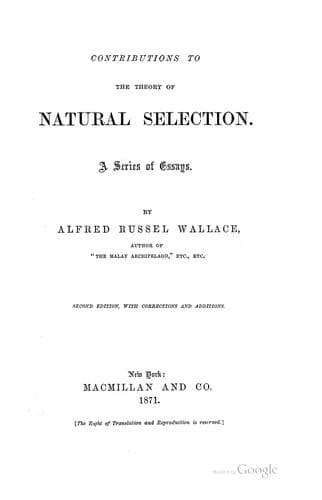
Contributions to the Theory of Natural Selection: A Series of EssaysWallace, Alfred Russel
Science
Contributions to the Theory of Natural Selection: A Series of Essays
Wallace, Alfred Russel
Natural selection
The phaenomena of geological distribution are exactly analogous to those
of geography. Closely allied species are found associated in the same
beds, and the change from species to species appears to have been as
gradual in time as in space. Geology, however, furnishes us with
positive proof of the extinction and production of species, though it
does not inform us how either has taken place. The extinction of
species, however, offers but little difficulty, and the _modus operandi_
has been well illustrated by Sir C. Lyell in his admirable
"Principles." Geological changes, however gradual, must occasionally
have modified external conditions to such an extent as to have rendered
the existence of certain species impossible. The extinction would in
most cases be effected by a gradual dying-out, but in some instances
there might have been a sudden destruction of a species of limited
range. To discover how the extinct species have from time to time been
replaced by new ones down to the very latest geological period, is the
most difficult, and at the same time the most interesting problem in the
natural history of the earth. The present inquiry, which seeks to
eliminate from known facts a law which has determined, to a certain
degree, what species could and did appear at a given epoch, may, it is
hoped, be considered as one step in the right direction towards a
complete solution of it.
_High Organization of very ancient Animals consistent with this Law._
Much discussion has of late years taken place on the question, whether
the succession of life upon the globe has been from a lower to a higher
degree of organization. The admitted facts seem to show that there has
been a general, but not a detailed progression. Mollusca and Radiata
existed before Vertebrata, and the progression from Fishes to Reptiles
and Mammalia, and also from the lower mammals to the higher, is
indisputable. On the other hand, it is said that the Mollusca and
Radiata of the very earliest periods were more highly organized than the
great mass of those now existing, and that the very first fishes that
have been discovered are by no means the lowest organised of the class.
Now it is believed the present hypothesis will harmonize with all these
facts, and in a great measure serve to explain them; for though it may
appear to some readers essentially a theory of progression, it is in
reality only one of gradual change. It is, however, by no means
difficult to show that a real progression in the scale of organization
is perfectly consistent with all the appearances, and even with apparent
retrogression, should such occur.
Public-domain text, read in full here on John Shaqi.
Reviews
Reviews
No reviews yet
Be the first to share your thoughts on this work.
Join the Discussion
Join the discussion
Sign in to leave a comment or review.
Sign InorCreate an account