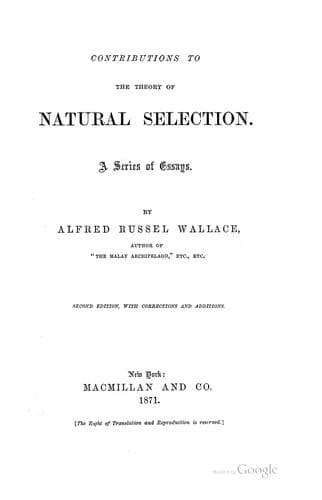
Contributions to the Theory of Natural Selection: A Series of EssaysWallace, Alfred Russel
Science
Contributions to the Theory of Natural Selection: A Series of Essays
Wallace, Alfred Russel
Natural selection
Returning to the analogy of a branching tree, as the best mode of
representing the natural arrangement of species and their successive
creation, let us suppose that at an early geological epoch any group
(say a class of the Mollusca) has attained to a great richness of
species and a high organization. Now let this great branch of allied
species, by geological mutations, be completely or partially destroyed.
Subsequently a new branch springs from the same trunk, that is to say,
new species are successively created, having for their antitypes the
same lower organized species which had served as the antitypes for the
former group, but which have survived the modified conditions which
destroyed it. This new group being subject to these altered conditions,
has modifications of structure and organization given to it, and
becomes the representative group of the former one in another geological
formation. It may, however, happen, that though later in time, the new
series of species may never attain to so high a degree of organization
as those preceding it, but in its turn become extinct, and give place to
yet another modification from the same root, which may be of higher or
lower organization, more or less numerous in species, and more or less
varied in form and structure than either of those which preceded it.
Again, each of these groups may not have become totally extinct, but may
have left a few species, the modified prototypes of which have existed
in each succeeding period, a faint memorial of their former grandeur and
luxuriance. Thus every case of apparent retrogression may be in reality
a progress, though an interrupted one: when some monarch of the forest
loses a limb, it may be replaced by a feeble and sickly substitute. The
foregoing remarks appear to apply to the case of the Mollusca, which, at
a very early period, had reached a high organization and a great
development of forms and species in the testaceous Cephalopoda. In each
succeeding age modified species and genera replaced the former ones
which had become extinct, and as we approach the present aera, but few
and small representatives of the group remain, while the Gasteropods and
Bivalves have acquired an immense preponderance. In the long series of
changes the earth has undergone, the process of peopling it with organic
beings has been continually going on, and whenever any of the higher
groups have become nearly or quite extinct, the lower forms which have
better resisted the modified physical conditions have served as the
antitypes on which to found the new races. In this manner alone, it is
believed, can the representative groups at successive periods, and the
risings and fallings in the scale of organization, be in every case
explained.
_Objections to Forbes' Theory of Polarity._
Public-domain text, read in full here on John Shaqi.
Reviews
Reviews
No reviews yet
Be the first to share your thoughts on this work.
Join the Discussion
Join the discussion
Sign in to leave a comment or review.
Sign InorCreate an account