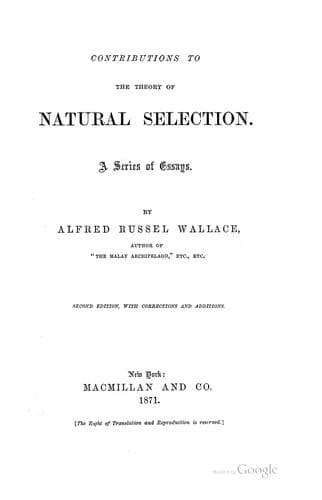
Contributions to the Theory of Natural Selection: A Series of EssaysWallace, Alfred Russel
Science
Contributions to the Theory of Natural Selection: A Series of Essays
Wallace, Alfred Russel
Natural selection
The hypothesis of polarity, recently put forward by Professor Edward
Forbes to account for the abundance of generic forms at a very early
period and at present, while in the intermediate epochs there is a
gradual diminution and impoverishment, till the minimum occurred at the
confines of the Palaeozoic and Secondary epochs, appears to us quite
unnecessary, as the facts may be readily accounted for on the principles
already laid down. Between the Palaeozoic and Neozoic periods of
Professor Forbes, there is scarcely a species in common, and the greater
part of the genera and families also disappear to be replaced by new
ones. It is almost universally admitted that such a change in the
organic world must have occupied a vast period of time. Of this interval
we have no record; probably because the whole area of the early
formations now exposed to our researches was elevated at the end of the
Palaeozoic period, and remained so through the interval required for the
organic changes which resulted in the fauna and flora of the Secondary
period. The records of this interval are buried beneath the ocean which
covers three-fourths of the globe. Now it appears highly probable that a
long period of quiescence or stability in the physical conditions of a
district would be most favourable to the existence of organic life in
the greatest abundance, both as regards individuals and also as to
variety of species and generic group, just as we now find that the
places best adapted to the rapid growth and increase of individuals also
contain the greatest profusion of species and the greatest variety of
forms,--the tropics in comparison with the temperate and arctic regions.
On the other hand, it seems no less probable that a change in the
physical conditions of a district, even small in amount if rapid, or
even gradual if to a great amount, would be highly unfavourable to the
existence of individuals, might cause the extinction of many species,
and would probably be equally unfavourable to the creation of new ones.
In this too we may find an analogy with the present state of our earth,
for it has been shown to be the violent extremes and rapid changes of
physical conditions, rather than the actual mean state in the temperate
and frigid zones, which renders them less prolific than the tropical
regions, as exemplified by the great distance beyond the tropics to
which tropical forms penetrate when the climate is equable, and also by
the richness in species and forms of tropical mountain regions which
principally differ from the temperate zone in the uniformity of their
climate. However this may be, it seems a fair assumption that during a
period of geological repose the new species which we know to have been
created would have appeared; that the creations would then exceed in
number the extinctions, and therefore the number of species would
increase. In a period of geological activity, on the other hand, it
Public-domain text, read in full here on John Shaqi.
Reviews
Reviews
No reviews yet
Be the first to share your thoughts on this work.
Join the Discussion
Join the discussion
Sign in to leave a comment or review.
Sign InorCreate an account