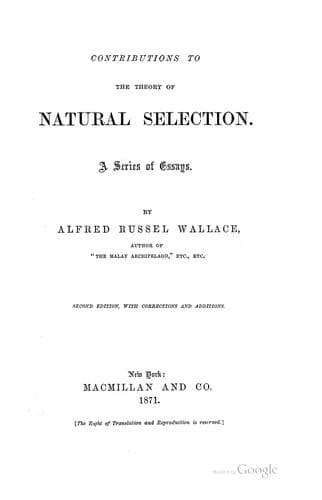
Contributions to the Theory of Natural Selection: A Series of EssaysWallace, Alfred Russel
Science
Contributions to the Theory of Natural Selection: A Series of Essays
Wallace, Alfred Russel
Natural selection
If we endeavour to decide impartially on the merits of this difficult
controversy, judging solely by the evidence that each party has brought
forward, it certainly seems that the best of the argument is on the
side of those who maintain the primitive diversity of man. Their
opponents have not been able to refute the permanence of existing races
as far back as we can trace them, and have failed to show, in a single
case, that at any former epoch the well marked varieties of mankind
approximated more closely than they do at the present day. At the same
time this is but negative evidence. A condition of immobility for four
or five thousand years, does not preclude an advance at an earlier
epoch, and--if we can show that there are causes in nature which would
check any further physical change when certain conditions were
fulfilled--does not even render such an advance improbable, if there are
any general arguments to be adduced in its favour. Such a cause, I
believe, does exist; and I shall now endeavour to point out its nature
and its mode of operation.
_Outline of the Theory of Natural Selection._
In order to make my argument intelligible, it is necessary for me to
explain very briefly the theory of "Natural Selection" promulgated by
Mr. Darwin, and the power which it possesses of modifying the forms of
animals and plants. The grand feature in the multiplication of organic
life is, that close general resemblance is combined with more or less
individual variation. The child resembles its parents or ancestors more
or less closely in all its peculiarities, deformities, or beauties; it
resembles them in general more than it does any other individuals; yet
children of the same parents are not all alike, and it often happens
that they differ very considerably from their parents and from each
other. This is equally true, of man, of all animals, and of all plants.
Moreover, it is found that individuals do not differ from their parents
in certain particulars only, while in all others they are exact
duplicates of them. They differ from them and from each other, in every
particular: in form, in size, in colour; in the structure of internal as
well as of external organs; in those subtle peculiarities which produce
differences of constitution, as well as in those still more subtle ones
which lead to modifications of mind and character. In other words, in
every possible way, in every organ and in every function, individuals of
the same stock vary.
Public-domain text, read in full here on John Shaqi.
Reviews
Reviews
No reviews yet
Be the first to share your thoughts on this work.
Elsewhere in the archive
Join the Discussion
Join the discussion
Sign in to leave a comment or review.
Sign InorCreate an account