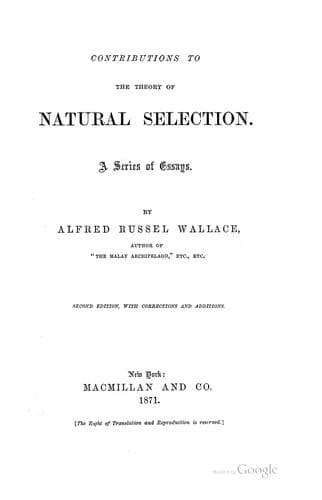
Contributions to the Theory of Natural Selection: A Series of EssaysWallace, Alfred Russel
Science
Contributions to the Theory of Natural Selection: A Series of Essays
Wallace, Alfred Russel
Natural selection
In the absence or scarcity of facts and observations as to _varieties_
occurring among wild animals, this argument has had great weight with
naturalists, and has led to a very general and somewhat prejudiced
belief in the stability of species. Equally general, however, is the
belief in what are called "permanent or true varieties,"--races of
animals which continually propagate their like, but which differ so
slightly (although constantly) from some other race, that the one is
considered to be a _variety_ of the other. Which is the _variety_ and
which the original _species_, there is generally no means of
determining, except in those rare cases in which the one race has been
known to produce an offspring unlike itself and resembling the other.
This, however, would seem quite incompatible with the "permanent
invariability of species," but the difficulty is overcome by assuming
that such varieties have strict limits, and can never again vary further
from the original type, although they may return to it, which, from the
analogy of the domesticated animals, is considered to be highly
probable, if not certainly proved.
It will be observed that this argument rests entirely on the assumption,
that _varieties_ occurring in a state of nature are in all respects
analogous to or even identical with those of domestic animals, and are
governed by the same laws as regards their permanence or further
variation. But it is the object of the present paper to show that this
assumption is altogether false, that there is a general principle in
nature which will cause many _varieties_ to survive the parent species,
and to give rise to successive variations departing further and further
from the original type; and which also produces, in domesticated
animals, the tendency of varieties to return to the parent form.
_The Struggle for Existence._
The life of wild animals is a struggle for existence. The full exertion
of all their faculties and all their energies is required to preserve
their own existence and provide for that of their infant offspring. The
possibility of procuring food during the least favourable seasons, and
of escaping the attacks of their most dangerous enemies, are the primary
conditions which determine the existence both of individuals and of
entire species. These conditions will also determine the population of a
species; and by a careful consideration of all the circumstances we may
be enabled to comprehend, and in some degree to explain, what at first
sight appears so inexplicable--the excessive abundance of some species,
while others closely allied to them are very rare.
_The Law of Population of Species._
Public-domain text, read in full here on John Shaqi.
Reviews
Reviews
No reviews yet
Be the first to share your thoughts on this work.
Join the Discussion
Join the discussion
Sign in to leave a comment or review.
Sign InorCreate an account