Contributions to the Theory of Natural Selection: A Series of Essays — John Shaqi
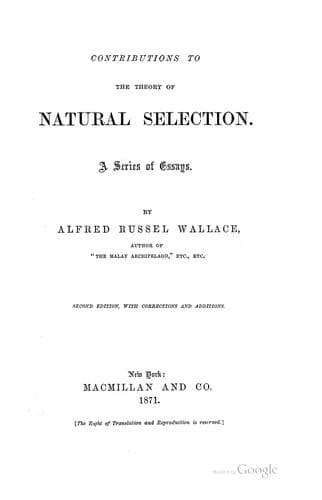
Contributions to the Theory of Natural Selection: A Series of EssaysWallace, Alfred Russel
Science
Contributions to the Theory of Natural Selection: A Series of Essays
Wallace, Alfred Russel
Natural selection
The general proportion that must obtain between certain groups of
animals is readily seen. Large animals cannot be so abundant as small
ones; the carnivora must be less numerous than the herbivora; eagles and
lions can never be so plentiful as pigeons and antelopes; and the wild
asses of the Tartarian deserts cannot equal in numbers the horses of the
more luxuriant prairies and pampas of America. The greater or less
fecundity of an animal is often considered to be one of the chief causes
of its abundance or scarcity; but a consideration of the facts will show
us that it really has little or nothing to do with the matter. Even the
least prolific of animals would increase rapidly if unchecked, whereas
it is evident that the animal population of the globe must be
stationary, or perhaps, through the influence of man, decreasing.
Fluctuations there may be; but permanent increase, except in restricted
localities, is almost impossible. For example, our own observation must
convince us that birds do not go on increasing every year in a
geometrical ratio, as they would do, were there not some powerful check
to their natural increase. Very few birds produce less than two young
ones each year, while many have six, eight, or ten; four will certainly
be below the average; and if we suppose that each pair produce young
only four times in their life, that will also be below the average,
supposing them not to die either by violence or want of food. Yet at
this rate how tremendous would be the increase in a few years from a
single pair! A simple calculation will show that in fifteen years each
pair of birds would have increased to nearly ten millions![E] whereas we
have no reason to believe that the number of the birds of any country
increases at all in fifteen or in one hundred and fifty years. With such
powers of increase the population must have reached its limits, and
have become stationary, in a very few years after the origin of each
species. It is evident, therefore, that each year an immense number of
birds must perish--as many in fact as are born; and as on the lowest
calculation the progeny are each year twice as numerous as their
parents, it follows that, whatever be the average number of individuals
existing in any given country, _twice that number must perish
annually_,--a striking result, but one which seems at least highly
probable, and is perhaps under rather than over the truth. It would
therefore appear that, as far as the continuance of the species and the
keeping up the average number of individuals are concerned, large broods
are superfluous. On the average all above _one_ become food for hawks
and kites, wild cats or weasels, or perish of cold and hunger as winter
comes on. This is strikingly proved by the case of particular species;
for we find that their abundance in individuals bears no relation
whatever to their fertility in producing offspring.
Public-domain text, read in full here on John Shaqi.
Reviews
Reviews
No reviews yet
Be the first to share your thoughts on this work.
Join the Discussion
Join the discussion
Sign in to leave a comment or review.
Sign InorCreate an account