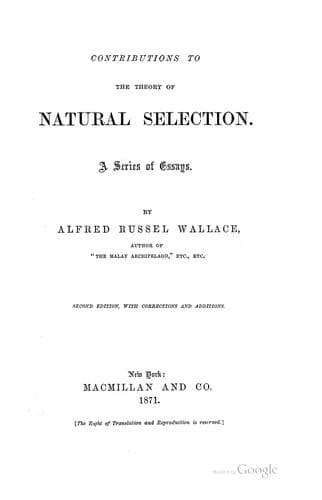
Contributions to the Theory of Natural Selection: A Series of EssaysWallace, Alfred Russel
Science
Contributions to the Theory of Natural Selection: A Series of Essays
Wallace, Alfred Russel
Natural selection
Most or perhaps all the variations from the typical form of a species
must have some definite effect, however slight, on the habits or
capacities of the individuals. Even a change of colour might, by
rendering them more or less distinguishable, affect their safety; a
greater or less development of hair might modify their habits. More
important changes, such as an increase in the power or dimensions of the
limbs or any of the external organs, would more or less affect their
mode of procuring food or the range of country which they could inhabit.
It is also evident that most changes would affect, either favourably or
adversely, the powers of prolonging existence. An antelope with shorter
or weaker legs must necessarily suffer more from the attacks of the
feline carnivora; the passenger pigeon with less powerful wings would
sooner or later be affected in its powers of procuring a regular supply
of food; and in both cases the result must necessarily be a diminution
of the population of the modified species. If, on the other hand, any
species should produce a variety having slightly increased powers of
preserving existence, that variety must inevitably in time acquire a
superiority in numbers. These results must follow as surely as old age,
intemperance, or scarcity of food produce an increased mortality. In
both cases there may be many individual exceptions; but on the average
the rule will invariably be found to hold good. All varieties will
therefore fall into two classes--those which under the same conditions
would never reach the population of the parent species, and those which
would in time obtain and keep a numerical superiority. Now, let some
alteration of physical conditions occur in the district--a long period
of drought, a destruction of vegetation by locusts, the irruption of
some new carnivorous animal seeking "pastures new"--any change in fact
tending to render existence more difficult to the species in question,
and tasking its utmost powers to avoid complete extermination; it is
evident that, of all the individuals composing the species, those
forming the least numerous and most feebly organized variety would
suffer first, and, were the pressure severe, must soon become extinct.
The same causes continuing in action, the parent species would next
suffer, would gradually diminish in numbers, and with a recurrence of
similar unfavourable conditions might also become extinct. Tho superior
variety would then alone remain, and on a return to favourable
circumstances would rapidly increase in numbers and occupy the place of
the extinct species and variety.
_Superior Varieties will ultimately Extirpate the original Species._
Public-domain text, read in full here on John Shaqi.
Reviews
Reviews
No reviews yet
Be the first to share your thoughts on this work.
Join the Discussion
Join the discussion
Sign in to leave a comment or review.
Sign InorCreate an account