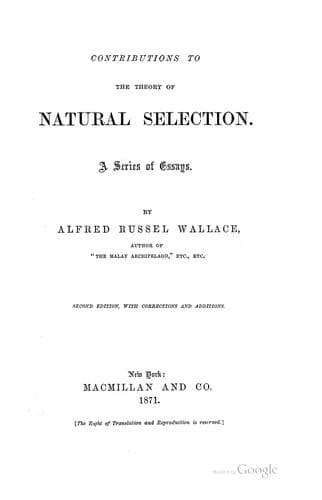
Contributions to the Theory of Natural Selection: A Series of EssaysWallace, Alfred Russel
Science
Contributions to the Theory of Natural Selection: A Series of Essays
Wallace, Alfred Russel
Natural selection
The _variety_ would now have replaced the _species_, of which it would
be a more perfectly developed and more highly organized form. It would
be in all respects better adapted to secure its safety, and to prolong
its individual existence and that of the race. Such a variety _could
not_ return to the original form; for that form is an inferior one, and
could never compete with it for existence. Granted, therefore, a
"tendency" to reproduce the original type of the species, still the
variety must ever remain preponderant in numbers, and under adverse
physical conditions _again alone survive_. But this new, improved, and
populous race might itself, in course of time, give rise to new
varieties, exhibiting several diverging modifications of form, any of
which, tending to increase the facilities for preserving existence,
must, by the same general law, in their turn become predominant. Here,
then, we have _progression and continued divergence_ deduced from the
general laws which regulate the existence of animals in a state of
nature, and from the undisputed fact that varieties do frequently occur.
It is not, however, contended that this result would be invariable; a
change of physical conditions in the district might at times materially
modify it, rendering the race which had been the most capable of
supporting existence under the former conditions now the least so, and
even causing the extinction of the newer and, for a time, superior race,
while the old or parent species and its first inferior varieties
continued to flourish. Variations in unimportant parts might also occur,
having no perceptible effect on the life-preserving powers; and the
varieties so furnished might run a course parallel with the parent
species, either giving rise to further variations or returning to the
former type. All we argue for is, that certain varieties have a tendency
to maintain their existence longer than the original species, and this
tendency must make itself felt; for though the doctrine of chances or
averages can never be trusted to on a limited scale, yet, if applied to
high numbers, the results come nearer to what theory demands, and, as we
approach to an infinity of examples, become strictly accurate. Now the
scale on which nature works is so vast--the numbers of individuals and
the periods of time with which she deals approach so near to infinity,
than any cause, however slight, and however liable to be veiled and
counteracted by accidental circumstances, must in the end produce its
full legitimate results.
_The Partial Reversion of Domesticated Varieties explained._
Public-domain text, read in full here on John Shaqi.
Reviews
Reviews
No reviews yet
Be the first to share your thoughts on this work.
Join the Discussion
Join the discussion
Sign in to leave a comment or review.
Sign InorCreate an account