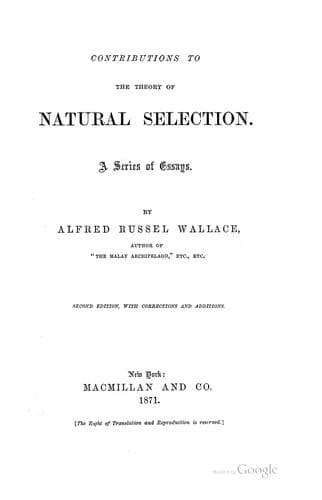
Contributions to the Theory of Natural Selection: A Series of EssaysWallace, Alfred Russel
Science
Contributions to the Theory of Natural Selection: A Series of Essays
Wallace, Alfred Russel
Natural selection
through a series of species differing considerably in more essential
characters. It also furnishes us with a reason for that "more
specialized structure" which Professor Owen states to be a
characteristic of recent compared with extinct forms, and which would
evidently be the result of the progressive modification of any organ
applied to a special purpose in the animal economy.
_Conclusion._
We believe we have now shown that there is a tendency in nature to the
continued progression of certain classes of _varieties_ further and
further from the original type--a progression to which there appears no
reason to assign any definite limits--and that the same principle which
produces this result in a state of nature will also explain why domestic
varieties have a tendency, when they become wild, to revert to the
original type. This progression, by minute steps, in various
directions, but always checked and balanced by the necessary conditions,
subject to which alone existence can be preserved, may, it is believed,
be followed out so as to agree with all the phaenomena presented by
organized beings, their extinction and succession in past ages, and all
the extraordinary modifications of form, instinct and habits which they
exhibit.
III.
MIMICRY, AND OTHER PROTECTIVE RESEMBLANCES AMONG ANIMALS.
There is no more convincing proof of the truth of a comprehensive
theory, than its power of absorbing and finding a place for new facts,
and its capability of interpreting phaenomena which had been previously
looked upon as unaccountable anomalies. It is thus that the law of
universal gravitation and the undulatory theory of light have become
established and universally accepted by men of science. Fact after fact
has been brought forward as being apparently inconsistent with them, and
one after another these very facts have been shown to be the
consequences of the laws they were at first supposed to disprove. A
false theory will never stand this test. Advancing knowledge brings to
light whole groups of facts which it cannot deal with, and its advocates
steadily decrease in numbers, notwithstanding the ability and scientific
skill with which it may have been supported. The great name of Edward
Forbes did not prevent his theory of "Polarity in the distribution of
Organic beings in Time" from dying a natural death; but the most
striking illustration of the behaviour of a false theory is to be found
in the "Circular and Quinarian System" of classification propounded by
MacLeay, and developed by Swainson, with an amount of knowledge and
ingenuity that have rarely been surpassed. This theory was eminently
attractive, both from its symmetry and completeness, and from the
interesting nature of the varied analogies and affinities which it
brought to light and made use of. The series of Natural History volumes
in "Lardner's Cabinet Cyclopaedia," in which Mr. Swainson developed it in
most departments of the animal kingdom, made it widely known; and in
Public-domain text, read in full here on John Shaqi.
Reviews
Reviews
No reviews yet
Be the first to share your thoughts on this work.
Join the Discussion
Join the discussion
Sign in to leave a comment or review.
Sign InorCreate an account