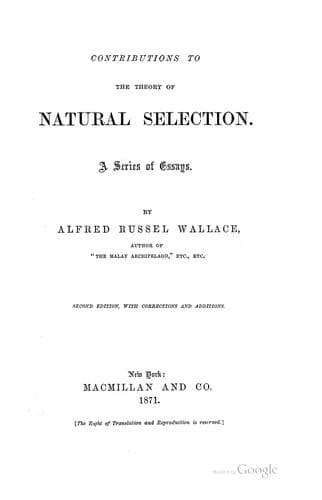
Contributions to the Theory of Natural Selection: A Series of EssaysWallace, Alfred Russel
Science
Contributions to the Theory of Natural Selection: A Series of Essays
Wallace, Alfred Russel
Natural selection
fact for a long time these were the best and almost the only popular
text-books for the rising generation of naturalists. It was favourably
received too by the older school, which was perhaps rather an indication
of its unsoundness. A considerable number of well-known naturalists
either spoke approvingly of it, or advocated similar principles, and for
a good many years it was decidedly in the ascendent. With such a
favourable introduction, and with such talented exponents, it must have
become established if it had had any germ of truth in it; yet it quite
died out in a few short years, its very existence is now a matter of
history; and so rapid was its fall that its talented creator, Swainson,
perhaps lived to be the last man who believed in it.
Such is the course of a false theory. That of a true one is very
different, as may be well seen by the progress of opinion on the subject
of Natural Selection. In less than eight years "The Origin of Species"
has produced conviction in the minds of a majority of the most eminent
living men of science. New facts, new problems, new difficulties as they
arise are accepted, solved or removed by this theory; and its principles
are illustrated by the progress and conclusions of every well
established branch of human knowledge. It is the object of the present
essay to show how it has recently been applied to connect together and
explain a variety of curious facts which had long been considered as
inexplicable anomalies.
_Importance of the Principle of Utility._
Perhaps no principle has ever been announced so fertile in results as
that which Mr. Darwin so earnestly impresses upon us, and which is
indeed a necessary deduction from the theory of Natural Selection,
namely--that none of the definite facts of organic nature, no special
organ, no characteristic form or marking, no peculiarities of instinct
or of habit, no relations between species or between groups of
species--can exist, but which must now be or once have been _useful_ to
the individuals or the races which possess them. This great principle
gives us a clue which we can follow out in the study of many recondite
phaenomena, and leads us to seek a meaning and a purpose of some definite
character in minutiae which we should be otherwise almost sure to pass
over as insignificant or unimportant.
_Popular Theories of Colour in Animals._
Public-domain text, read in full here on John Shaqi.
Reviews
Reviews
No reviews yet
Be the first to share your thoughts on this work.
Join the Discussion
Join the discussion
Sign in to leave a comment or review.
Sign InorCreate an account