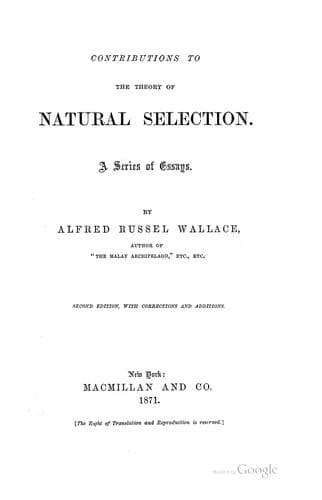
Contributions to the Theory of Natural Selection: A Series of EssaysWallace, Alfred Russel
Science
Contributions to the Theory of Natural Selection: A Series of Essays
Wallace, Alfred Russel
Natural selection
Concealment, more or less complete, is useful to many animals, and
absolutely essential to some. Those which have numerous enemies from
which they cannot escape by rapidity of motion, find safety in
concealment. Those which prey upon others must also be so constituted as
not to alarm them by their presence or their approach, or they would
soon die of hunger. Now it is remarkable in how many cases nature gives
this boon to the animal, by colouring it with such tints as may best
serve to enable it to escape from its enemies or to entrap its prey.
Desert animals as a rule are desert-coloured. The lion is a typical
example of this, and must be almost invisible when crouched upon the
sand or among desert rocks and stones. Antelopes are all more or less
sandy-coloured. The camel is pre-eminently so. The Egyptian cat and the
Pampas cat are sandy or earth-coloured. The Australian kangaroos are of
the same tints, and the original colour of the wild horse is supposed to
have been a sandy or clay-colour.
The desert birds are still more remarkably protected by their
assimilative hues. The stonechats, the larks, the quails, the
goatsuckers and the grouse, which abound in the North African and
Asiatic deserts, are all tinted and mottled so as to resemble with
wonderful accuracy the average colour and aspect of the soil in the
district they inhabit. The Rev. H. Tristram, in his account of the
ornithology of North Africa in the 1st volume of the "Ibis," says: "In
the desert, where neither trees, brush-wood, nor even undulation of the
surface afford the slightest protection to its foes, a modification of
colour which shall be assimilated to that of the surrounding country, is
absolutely necessary. Hence _without exception_ the upper plumage of
_every bird_, whether lark, chat, sylvain, or sand-grouse, and also the
fur of _all the smaller mammals_, and the skin of _all the snakes and
lizards_, is of one uniform isabelline or sand colour." After the
testimony of so able an observer it is unnecessary to adduce further
examples of the protective colours of desert animals.
Public-domain text, read in full here on John Shaqi.
Reviews
Reviews
No reviews yet
Be the first to share your thoughts on this work.
Join the Discussion
Join the discussion
Sign in to leave a comment or review.
Sign InorCreate an account