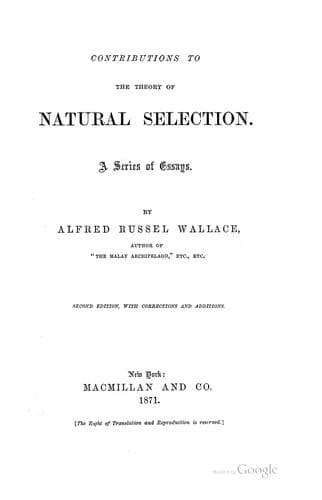
Contributions to the Theory of Natural Selection: A Series of EssaysWallace, Alfred Russel
Science
Contributions to the Theory of Natural Selection: A Series of Essays
Wallace, Alfred Russel
Natural selection
Almost equally striking are the cases of arctic animals possessing the
white colour that best conceals them upon snowfields and icebergs. The
polar bear is the only bear that is white, and it lives constantly among
snow and ice. The arctic fox, the ermine and the alpine hare change to
white in winter only, because in summer white would be more conspicuous
than any other colour, and therefore a danger rather than a protection;
but the American polar hare, inhabiting regions of almost perpetual
snow, is white all the year round. Other animals inhabiting the same
Northern regions do not, however, change colour. The sable is a good
example, for throughout the severity of a Siberian winter it retains its
rich brown fur. But its habits are such that it does not need the
protection of colour, for it is said to be able to subsist on fruits and
berries in winter, and to be so active upon the trees as to catch small
birds among the branches. So also the woodchuck of Canada has a
dark-brown fur; but then it lives in burrows and frequents river banks,
catching fish and small animals that live in or near the water.
Among birds, the ptarmigan is a fine example of protective colouring.
Its summer plumage so exactly harmonizes with the lichen-coloured stones
among which it delights to sit, that a person may walk through a flock
of them without seeing a single bird; while in winter its white plumage
is an almost equal protection. The snow-bunting, the jer-falcon, and the
snowy owl are also white-coloured birds inhabiting the arctic regions,
and there can be little doubt but that their colouring is to some extent
protective.
Nocturnal animals supply us with equally good illustrations. Mice, rats,
bats, and moles possess the least conspicuous of hues, and must be quite
invisible at times when any light colour would be instantly seen. Owls
and goatsuckers are of those dark mottled tints that will assimilate
with bark and lichen, and thus protect them during the day, and at the
same time be inconspicuous in the dusk.
It is only in the tropics, among forests which never lose their foliage,
that we find whole groups of birds whose chief colour is green. The
parrots are the most striking example, but we have also a group of green
pigeons in the East; and the barbets, leaf-thrushes, bee-eaters,
white-eyes, turacos, and several smaller groups, have so much green in
their plumage as to tend greatly to conceal them among the foliage.
_Special Modifications of Colour._
Public-domain text, read in full here on John Shaqi.
Reviews
Reviews
No reviews yet
Be the first to share your thoughts on this work.
Join the Discussion
Join the discussion
Sign in to leave a comment or review.
Sign InorCreate an account