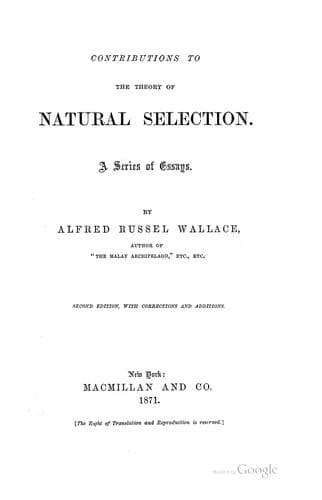
Contributions to the Theory of Natural Selection: A Series of EssaysWallace, Alfred Russel
Science
Contributions to the Theory of Natural Selection: A Series of Essays
Wallace, Alfred Russel
Natural selection
There are in the East small beetles of the family Buprestidae which
generally rest on the midrib of a leaf, and the naturalist often
hesitates before picking them off, so closely do they resemble pieces of
bird's dung. Kirby and Spence mention the small beetle Onthophilus
sulcatus as being like the seed of an umbelliferous plant; and another
small weevil, which is much persecuted by predatory beetles of the genus
Harpalus, is of the exact colour of loamy soil, and was found to be
particularly abundant in loam pits. Mr. Bates mentions a small beetle
(Chlamys pilula) which was undistinguishable by the eye from the dung of
caterpillars, while some of the Cassidae, from their hemispherical forms
and pearly gold colour, resemble glittering dew-drops upon the leaves.
A number of our small brown and speckled weevils at the approach of any
object roll off the leaf they are sitting on, at the same time drawing
in their legs and antennae, which fit so perfectly into cavities for
their reception that the insect becomes a mere oval brownish lump, which
it is hopeless to look for among the similarly coloured little stones
and earth pellets among which it lies motionless.
The distribution of colour in butterflies and moths respectively is very
instructive from this point of view. The former have all their brilliant
colouring on the upper surface of all four wings, while the under
surface is almost always soberly coloured, and often very dark and
obscure. The moths on the contrary have generally their chief colour on
the hind wings only, the upper wings being of dull, sombre, and often
imitative tints, and these generally conceal the hind wings when the
insects are in repose. This arrangement of the colours is therefore
eminently protective, because the butterfly always rests with his wings
raised so as to conceal the dangerous brilliancy of his upper surface.
It is probable that if we watched their habits sufficiently we should
find the under surface of the wings of butterflies very frequently
imitative and protective. Mr. T. W. Wood has pointed out that the little
orange-tip butterfly often rests in the evening on the green and white
flower heads of an umbelliferous plant, and that when observed in this
position the beautiful green and white mottling of the under surface
completely assimilates with the flower heads and renders the creature
very difficult to be seen. It is probable that the rich dark colouring
of the under side of our peacock, tortoiseshell, and red-admiral
butterflies answers a similar purpose.
Public-domain text, read in full here on John Shaqi.
Reviews
Reviews
No reviews yet
Be the first to share your thoughts on this work.
Join the Discussion
Join the discussion
Sign in to leave a comment or review.
Sign InorCreate an account