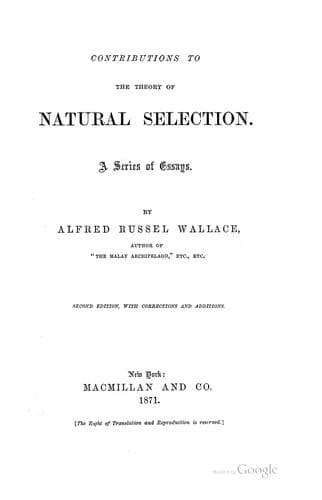
Contributions to the Theory of Natural Selection: A Series of EssaysWallace, Alfred Russel
Science
Contributions to the Theory of Natural Selection: A Series of Essays
Wallace, Alfred Russel
Natural selection
It is, however, in the insect world that this principle of the
adaptation of animals to their environment is most fully and strikingly
developed. In order to understand how general this is, it is necessary
to enter somewhat into details, as we shall thereby be better able to
appreciate the significance of the still more remarkable phenomena we
shall presently have to discuss. It seems to be in proportion to their
sluggish motions or the absence of other means of defence, that insects
possess the protective colouring. In the tropics there are thousands of
species of insects which rest during the day clinging to the bark of
dead or fallen trees; and the greater portion of these are delicately
mottled with gray and brown tints, which though symmetrically disposed
and infinitely varied, yet blend so completely with the usual colours of
the bark, that at two or three feet distance they are quite
undistinguishable. In some cases a species is known to frequent only one
species of tree. This is the case with the common South American
long-horned beetle (Onychocerus scorpio) which, Mr. Bates informed me,
is found only on a rough-barked tree, called Tapiriba, on the Amazon. It
is very abundant, but so exactly does it resemble the bark in colour and
rugosity, and so closely does it cling to the branches, that until it
moves it is absolutely invisible! An allied species (O. concentricus)
is found only at Para, on a distinct species of tree, the bark of which
it resembles with equal accuracy. Both these insects are abundant, and
we may fairly conclude that the protection they derive from this strange
concealment is at least one of the causes that enable the race to
flourish.
Many of the species of Cicindela, or tiger beetle, will illustrate this
mode of protection. Our common Cicindela campestris frequents grassy
banks, and is of a beautiful green colour, while C. maritima, which is
found only on sandy sea-shores, is of a pale bronzy yellow, so as to be
almost invisible. A great number of the species found by myself in the
Malay islands are similarly protected. The beautiful Cicindela gloriosa,
of a very deep velvety green colour, was only taken upon wet mossy
stones in the bed of a mountain stream, where it was with the greatest
difficulty detected. A large brown species (C. heros) was found chiefly
on dead leaves in forest paths; and one which was never seen except on
the wet mud of salt marshes was of a glossy olive so exactly the colour
of the mud as only to be distinguished when the sun shone, by its
shadow! Where the sandy beach was coralline and nearly white, I found a
very pale Cicindela; wherever it was volcanic and black, a dark species
of the same genus was sure to be met with.
Public-domain text, read in full here on John Shaqi.
Reviews
Reviews
No reviews yet
Be the first to share your thoughts on this work.
Join the Discussion
Join the discussion
Sign in to leave a comment or review.
Sign InorCreate an account