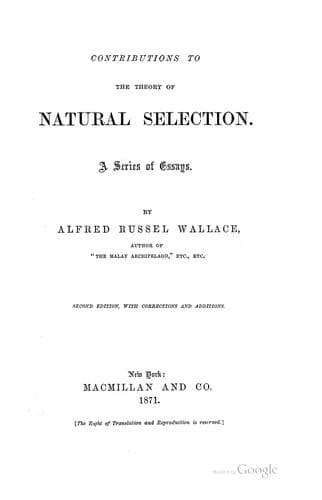
Contributions to the Theory of Natural Selection: A Series of EssaysWallace, Alfred Russel
Science
Contributions to the Theory of Natural Selection: A Series of Essays
Wallace, Alfred Russel
Natural selection
At the same meeting Mr. A. G. Butler, of the British Museum,
communicated the results of his observations with lizards, frogs, and
spiders, which strikingly corroborate those of Mr. Weir. Three green
lizards (Lacerta viridis) which he kept for several years, were very
voracious, eating all kinds of food, from a lemon cheesecake to a
spider, and devouring flies, caterpillars, and humble bees; yet there
were some caterpillars and moths which they would seize only to drop
immediately. Among these the principal were the caterpillar of the
Magpie moth (Abraxas grossulariata) and the perfect six spot Burnet moth
(Anthrocera filipendulae). These would be first seized but invariably
dropped in disgust, and afterwards left unmolested. Subsequently frogs
were kept and fed with caterpillars from the garden, but two of
these--that of the before-mentioned Magpie moth, and that of the V. moth
(Halia wavaria), which is green with conspicuous white or yellow stripes
and black spots--were constantly rejected. When these species were first
offered, the frogs sprang at them eagerly and licked them into their
mouths; no sooner, however, had they done so than they seemed to be
aware of the mistake that they had made, and sat with gaping mouths,
rolling their tongues about until they had got quit of the nauseous
morsels.
With spiders the same thing occurred. These two caterpillars were
repeatedly put into the webs both of the geometrical and hunting spiders
(Epeira diadema and Lycosa sp.), but in the former case they were cut
out and allowed to drop; in the latter, after disappearing in the jaws
of their captor down his dark silken funnel, they invariably reappeared,
either from below or else taking long strides up the funnel again. Mr.
Butler has observed lizards fight with and finally devour humble bees,
and a frog sitting on a bed of stone-crop leap up and catch the bees
which flew over his head, and swallow them, in utter disregard of their
stings. It is evident, therefore, that the possession of a disagreeable
taste or odour is a more effectual protection to certain conspicuous
caterpillars and moths, than would be even the possession of a sting.
The observations of these two gentlemen supply a very remarkable
confirmation of the hypothetical solution of the difficulty which I had
given two years before. And as it is generally acknowledged that the
best test of the truth and completeness of a theory is the power which
it gives us of prevision, we may I think fairly claim this as a case in
which the power of prevision has been successfully exerted, and
therefore as furnishing a very powerful argument in favour of the truth
of the theory of Natural Selection.
_Summary._
Public-domain text, read in full here on John Shaqi.
Reviews
Reviews
No reviews yet
Be the first to share your thoughts on this work.
Elsewhere in the archive
Join the Discussion
Join the discussion
Sign in to leave a comment or review.
Sign InorCreate an account