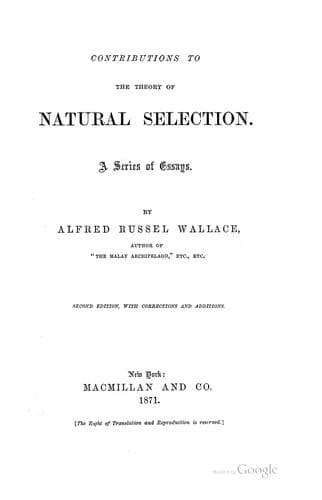
Contributions to the Theory of Natural Selection: A Series of EssaysWallace, Alfred Russel
Science
Contributions to the Theory of Natural Selection: A Series of Essays
Wallace, Alfred Russel
Natural selection
I have now completed a brief, and necessarily very imperfect, survey of
the various ways in which the external form and colouring of animals is
adapted to be useful to them, either by concealing them from their
enemies or from the creatures they prey upon. It has, I hope, been shown
that the subject is one of much interest, both as regard a true
comprehension of the place each animal fills in the economy of nature,
and the means by which it is enabled to maintain that place; and also as
teaching us how important a part is played by the minutest details in
the structure of animals, and how complicated and delicate is the
equilibrium of the organic world.
My exposition of the subject having been necessarily somewhat lengthy
and full of details, it will be as well to recapitulate its main points.
There is a general harmony in nature between the colours of an animal
and those of its habitation. Arctic animals are white, desert animals
are sand-coloured; dwellers among leaves and grass are green; nocturnal
animals are dusky. These colours are not universal, but are very
general, and are seldom reversed. Going on a little further, we find
birds, reptiles, and insects, so tinted and mottled as exactly to match
the rock, or bark, or leaf, or flower, they are accustomed to rest
upon,--and thereby effectually concealed. Another step in advance, and
we have insects which are formed as well as coloured so as exactly to
resemble particular leaves, or sticks, or mossy twigs, or flowers; and
in these cases very peculiar habits and instincts come into play to aid
in the deception and render the concealment more complete. We now enter
upon a new phase of the phenomena, and come to creatures whose colours
neither conceal them nor make them like vegetable or mineral substances;
on the contrary, they are conspicuous enough, but they completely
resemble some other creature of a quite different group, while they
differ much in outward appearance from those with which all essential
parts of their organization show them to be really closely allied. They
appear like actors or masqueraders dressed up and painted for amusement,
or like swindlers endeavouring to pass themselves off for well-known and
respectable members of society. What is the meaning of this strange
travestie? Does Nature descend to imposture or masquerade? We answer,
she does not. Her principles are too severe. There is a use in every
detail of her handiwork. The resemblance of one animal to another is of
exactly the same essential nature as the resemblance to a leaf, or to
bark, or to desert sand, and answers exactly the same purpose. In the
one case the enemy will not attack the leaf or the bark, and so the
disguise is a safeguard; in the other case it is found that for various
reasons the creature resembled is passed over, and not attacked by the
usual enemies of its order, and thus the creature that resembles it has
an equally effectual safeguard. We are plainly shown that the disguise
Public-domain text, read in full here on John Shaqi.
Reviews
Reviews
No reviews yet
Be the first to share your thoughts on this work.
Elsewhere in the archive
Join the Discussion
Join the discussion
Sign in to leave a comment or review.
Sign InorCreate an account