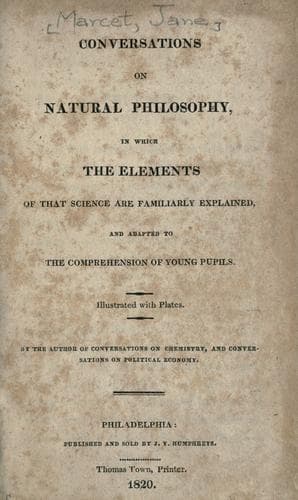
Conversations on Natural Philosophy, in which the Elements of that Science are Familiarly ExplainedMarcet, Mrs. (Jane Haldimand)
Science
Conversations on Natural Philosophy, in which the Elements of that Science are Familiarly Explained
Marcet, Mrs. (Jane Haldimand)
Physics
42. (Pg. 98) Two pendulums of the same length, will not, in different
latitudes, perform their vibrations in equal times, what is the cause of
this?
43. (Pg. 98) To what use has this property of the pendulum been applied?
44. (Pg. 99) What change must be made in pendulums situated at the
equator and at the poles, to render their vibrations equal?
45. (Pg. 99) What do the vibrations of a pendulum resemble, and why will
it vibrate more rapidly if shortened?
46. (Pg. 99) In the revolution of the earth round the sun, what is the
position of its axis?
47. (Pg. 99) How much is the axis of the earth inclined, and with what
line does it form this angle?
48. (Pg. 99) What is represented by fig. 2, plate 9?
49. (Pg. 100) How is the north pole inclined in the middle of our
summer, and what effect has this on the north frigid zone?
50. (Pg. 100) In what direction does the north pole always point?
51. (Pg. 100) What is shown by the position of the earth at B, in the
figure?
52. (Pg. 100) How does the sun then shine at the poles, and what is the
effect on the days and nights?
53. (Pg. 101) When the earth has passed the autumnal equinox, what
changes take place at the poles, and also in the whole northern and
southern hemispheres?
54. (Pg. 101) Why is the heat greatest within the torrid zone?
55. (Pg. 101) How does the sun appear at the poles, during the period of
day there?
56. (Pg. 101) In what will the days and nights differ in the temperate
zone, from those at the poles, and at the equator?
57. (Pg. 102) Trace the earth from the winter solstice to the vernal
equinox, and inform me what changes take place.
58. (Pg. 102) What takes place at the time of the vernal equinox, and
what is meant by the term?
59. (Pg. 102) In proceeding from the vernal equinox to the summer
solstice, what changes take place?
60. (Pg. 103) From what cause arises the superior heat of the equatorial
regions?
61. (Pg. 103) Why should oblique rays afford less heat than those which
are perpendicular?
62. (Pg. 103) How is this explained by fig. 1. plate 10?
63. (Pg. 103) How do you account for the superior heat of summer, and
how is this exemplified in fig. 2 and 3, plate 10?
64. (Pg. 104) What other cause lessens the intensity of oblique rays?
65. (Pg. 104) How is this explained by fig. 4?
66. (Pg. 104) What causes conspire to lessen the solar heat in the
morning and evening?
67. (Pg. 104) The greatest heat of summer is after the solstice, and the
greatest heat of the day, after 12 o'clock, although the sun's rays are
then most direct, how is this accounted for?
68. (Pg. 105) Is there any change of seasons in the other planets?
69. (Pg. 105) What is said respecting the axes of Jupiter, of Mars, and
of Saturn?
70. (Pg. 105) In 365 days, how many times does the earth revolve on its
axis?
71. (Pg. 105) How is this accounted for?
72. (Pg. 105) Do the fixed stars require the same time as the sun, to
return to the same meridian?
Public-domain text, read in full here on John Shaqi.
Reviews
Reviews
No reviews yet
Be the first to share your thoughts on this work.
Elsewhere in the archive
Join the Discussion
Join the discussion
Sign in to leave a comment or review.
Sign InorCreate an account