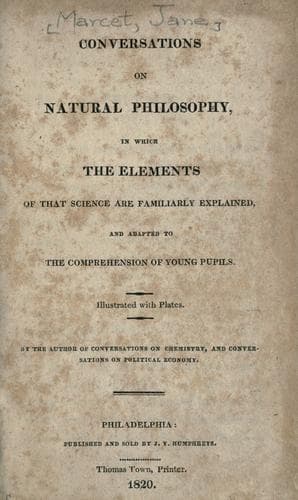
Conversations on Natural Philosophy, in which the Elements of that Science are Familiarly ExplainedMarcet, Mrs. (Jane Haldimand)
Science
Conversations on Natural Philosophy, in which the Elements of that Science are Familiarly Explained
Marcet, Mrs. (Jane Haldimand)
Physics
_Emily._ That is four hours later than in London: four times fifteen
degrees, make 60; he would, therefore, be sixty degrees east of London,
for the sun must have passed his meridian before it reaches that of
London.
_Mrs. B._ For this reason the hour is always later than in London, when
the place is east longitude, and earlier when it is west longitude. Thus
the longitude can be ascertained whenever the eclipses of Jupiter's
moons are visible.
_Caroline._ But do not the primary planets, sometimes eclipse the sun
from each other, as they pass round in their orbits?
_Mrs. B._ They must of course sometimes pass between each other and the
sun, but as their shadows never reach each other, they hide so little of
his light, that the term eclipse is not in this case used; this
phenomenon is called a transit. The primary planets do not any of them
revolve in the same plane, and the times of their revolution round the
sun is considerable, it therefore but rarely happens that they are at
the same time, in conjunction with the sun, and in their nodes. It is
evident also, that a planet must be inferior (that is within the orbit
of another) in order to its apparently passing over the disk of the sun.
Mercury, and Venus, have sometimes passed in a right line between us,
and the sun, but being at so great a distance from us, their shadows did
not extend so far as the earth; no darkness was therefore produced on
any part of our globe; but the planet appeared like a small black spot,
passing across the sun's disk.
It was by the last transit of Venus, that astronomers were enabled to
calculate, with some degree of accuracy, the distance of the earth from
the sun, and the dimensions of the latter.
_Emily._ I have heard that the tides are affected by the moon, but I
cannot conceive what influence it can have on them.
_Mrs. B._ They are produced by the moon's attraction, which draws up the
waters of that part of the ocean over which the moon passes, so as to
cause it to stand considerably higher than the surrounding parts.
_Caroline._ Does attraction act on water more powerfully than on land? I
should have thought it would have been just the contrary, for land is
certainly a more dense body than water?
_Mrs B._ Tides do not arise from water being more strongly attracted
than land, for this certainly is not the case; but the cohesion of
fluids, being much less than that of solid bodies, they more easily
yield to the power of gravity; in consequence of which, the waters
immediately below the moon, are drawn up by it, producing a full tide,
or what is commonly called, high water, at the spot where it happens. So
far, the theory of the tides is not difficult to understand.
_Caroline._ On the contrary, nothing can be more simple; the waters, in
order to rise up under the moon, must draw the waters from the opposite
side of the globe, and occasion ebb-tide, or low water, in those parts.
Public-domain text, read in full here on John Shaqi.
Reviews
Reviews
No reviews yet
Be the first to share your thoughts on this work.
Elsewhere in the archive
Join the Discussion
Join the discussion
Sign in to leave a comment or review.
Sign InorCreate an account