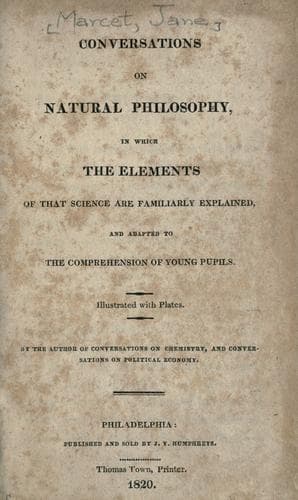
Conversations on Natural Philosophy, in which the Elements of that Science are Familiarly ExplainedMarcet, Mrs. (Jane Haldimand)
Science
Conversations on Natural Philosophy, in which the Elements of that Science are Familiarly Explained
Marcet, Mrs. (Jane Haldimand)
Physics
_Mrs. B._ You draw your conclusion rather too hastily, my dear; for
according to your theory, we should have full tide only once in about
twenty-four hours, that is, every time that we were below the moon,
while we find that in this time we have two tides, and that it is high
water with us, and with our antipodes, at the same time.
_Caroline._ Yet it must be impossible for the moon to attract the sea in
opposite parts of the globe, and in opposite directions, at the same
time.
_Mrs. B._ This opposite tide, is rather more difficult to explain, than
that which is immediately beneath the moon; with a little attention,
however, I hope I shall be able to make you understand the explanation
which has been given of it, by astronomers. It must be confessed,
however, that the theory upon this subject, is attended with some
difficulties. You recollect that the earth and the moon mutually attract
each other, but do you suppose that every part of the earth is equally
attracted by the moon?
_Emily._ Certainly not; you have taught us that the force of attraction
decreases, with the increase of distance, and therefore that part of the
earth which is farthest from the moon, must be attracted less
powerfully, than that to which she is nearest.
_Mrs. B._ This fact will aid us in the explanation which I am about to
give to you.
In order to render the question more simple, let us suppose the earth to
be every where covered by the ocean, as represented in (fig. 3. pl. 12.)
M is the moon, A B C D the earth. Now the waters on the surface of the
earth, about A, being more strongly attracted than any other part, will
be elevated: the attraction of the moon at B and C being less, and at D
least of all. The high tide at A, is accounted for from the direct
attraction of the moon; to produce this the waters are drawn from B and
C, where it will consequently be low water. At D, the attraction of the
moon being considerably decreased, the waters are left relatively high,
which height is increased, by the centrifugal force of the earth being
greater at D than at A, in consequence of its greater distance from the
common centre of gravity X, between the earth and the moon.
_Emily._ The tide A, then, is produced by the moon's attraction, and the
tide D, is produced by the centrifugal force, and increased by the
feebleness of the moon's attraction, in those parts.
_Caroline._ And when it is high water at A and D, it is low water at B
and C: now I think I comprehend the nature of the tides, though I
confess it is not quite so easy as I at first thought.
But, Mrs. B., why does not the sun produce tides, as well as the moon;
for its attraction is greater than that of the moon?
_Mrs. B._ It would be at an equal distance, but our vicinity to the
moon, makes her influence more powerful. The sun has, however, a
considerable effect on the tides, and increases or diminishes them as it
acts in conjunction with, or in opposition to the moon.
Public-domain text, read in full here on John Shaqi.
Reviews
Reviews
No reviews yet
Be the first to share your thoughts on this work.
Elsewhere in the archive
Join the Discussion
Join the discussion
Sign in to leave a comment or review.
Sign InorCreate an account