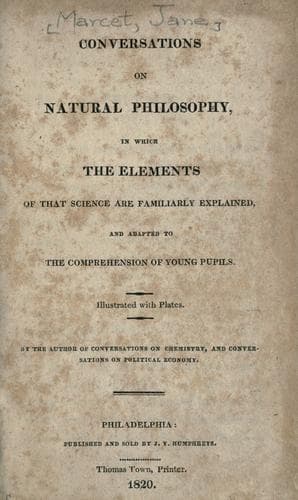
Conversations on Natural Philosophy, in which the Elements of that Science are Familiarly ExplainedMarcet, Mrs. (Jane Haldimand)
Science
Conversations on Natural Philosophy, in which the Elements of that Science are Familiarly Explained
Marcet, Mrs. (Jane Haldimand)
Physics
_Emily._ I do not quite understand that.
_Mrs. B._ The moon is a month in going round the earth; twice during
that time, therefore, at full and at change, she is in the same
direction as the sun; both, then act in conjunction on the earth, and
produce very great tides, called spring tides, as represented in fig. 4,
at A and B; but when the moon is at the intermediate parts of her orbit,
that is in her quadratures, the sun, instead of affording assistance,
weakens her power, by acting in opposition to it; and smaller tides are
produced, called neap tides, as represented at M, in fig. 5.
_Emily._ I have often observed the difference of these tides, when I
have been at the sea side.
But since attraction is mutual between the moon and the earth, we must
produce tides in the moon; and these must be more considerable in
proportion as our planet is larger. And yet the moon does not appear of
an oval form.
_Mrs. B._ You must recollect, that in order to render the explanation of
the tides clearer, we suppose the whole surface of the earth to be
covered with the ocean; but that is not really the case, either with the
earth or the moon, and the land which intersects the water, destroys the
regularity of the effect. Thus, in flowing up rivers, in passing round
points of land, and into bays and inlets, the water is obstructed, and
high water must happen much later, than would otherwise be the case.
_Caroline._ True; we may, however, be certain that whenever it is high
water, the moon is immediately over our heads.
_Mrs. B._ Not so either; for as a similar effect is produced on that
part of the globe immediately beneath the moon, and on that part most
distant from it, it cannot be over the heads of the inhabitants of both
those situations, at the same time. Besides, as the orbit of the moon is
very nearly parallel to that of the earth, she is never vertical, but to
the inhabitants of the torrid zone.
_Caroline._ In the torrid zone, then, I hope you will grant that the
moon is immediately over, or opposite the spots where it is high water?
_Mrs. B._ I cannot even admit that; for the ocean naturally partaking of
the earth's motion, in its rotation from west to east, the moon, in
forming a tide, has to contend against the eastern motion of the waves.
All matter, you know, by its inertia, makes some resistance to a change
of state; the waters, therefore, do not readily yield to the attraction
of the moon, and the effect of her influence is not complete, till three
hours after she has passed the meridian, where it is full tide.
When a body is impelled by any force, its motion may continue, after the
impelling force ceases to act: this is the case with all projectiles. A
stone thrown from the hand, continues its motion for a length of time,
proportioned to the force given to it: there is a perfect analogy
between this effect, and the continued rise of the water, after the moon
has passed the meridian at any particular place.
Public-domain text, read in full here on John Shaqi.
Reviews
Reviews
No reviews yet
Be the first to share your thoughts on this work.
Elsewhere in the archive
Join the Discussion
Join the discussion
Sign in to leave a comment or review.
Sign InorCreate an account