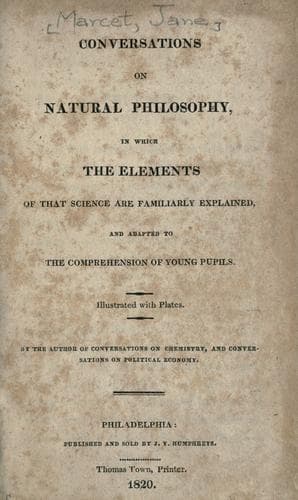
Conversations on Natural Philosophy, in which the Elements of that Science are Familiarly ExplainedMarcet, Mrs. (Jane Haldimand)
Science
Conversations on Natural Philosophy, in which the Elements of that Science are Familiarly Explained
Marcet, Mrs. (Jane Haldimand)
Physics
_Emily._ Pray what is the reason that the tide is three-quarters of an
hour later every day?
_Mrs. B._ Because it is twenty-four hours and three-quarters before the
same meridian, on our globe, returns beneath the moon. The earth
revolves on its axis in about twenty-four hours; if the moon were
stationary, therefore, the same part of our globe would, every
twenty-four hours, return beneath the moon; but as during our daily
revolution, the moon advances in her orbit, the earth must make more
than a complete rotation, in order to bring the same meridian opposite
the moon: we are three-quarters of an hour in overtaking her. The tides,
therefore, are retarded, for the same reason that the moon rises later
by three-quarters of an hour, every day.
We have now, I think, concluded the observations I had to make to you on
the subject of astronomy; at our next interview, I shall attempt to
explain to you the elements of hydrostatics.
Questions
1. (Pg. 108) In what time does the moon revolve round the earth? what is
the inclination of her orbit? and how does she accompany the earth?
2. (Pg. 108) As the moon revolves round the earth, and also accompanies
it in its annual revolution, in what form would you draw the moon's
orbit?
3. (Pg. 109) What causes the moon always to present the same face to the
earth, and what must be the length of a day and night to its
inhabitants?
4. (Pg. 109) Can the earth be seen from every part of the moon, and will
it always exhibit the same appearance?
5. (Pg. 109) What are the changes of the moon called?
6. (Pg. 109) How are these changes explained by fig. 2. plate 11?
7. (Pg. 109) What is meant by her first quarter?
8. (Pg. 109) What by her being horned, and her being gibbous?
9. (Pg. 109) What by her being full?
10. (Pg. 109) What by her third quarter?
11. (Pg. 110) What is meant by her conjunction?--what by her being in
opposition?--what by her quadratures?
12. (Pg. 110) By what are eclipses of the sun caused?
13. (Pg. 110) What causes eclipses of the moon?
14. (Pg. 110) What is meant by the moon's nodes?
15. (Pg. 110) Why do not eclipses happen at every new and full moon?
16. (Pg. 110) What causes partial eclipses of the moon?
17. (Pg. 110) When the moon is exactly in one of her nodes, what length
of time will she be eclipsed?
18. (Pg. 110) Are total eclipses of the sun frequent, and when they
happen what is their extent?
19. (Pg. 111) What does this prove respecting the size of the moon?
20. (Pg. 111) What is shown in fig. 1, plate 12?
21. (Pg. 111) How are lunar eclipses visible, and what is proved by
their duration?
22. (Pg. 111) What is illustrated by fig. 2, plate 12?
23. (Pg. 111) What remark is made respecting those planets which have
several moons?
24. (Pg. 111) What use is made of the eclipses of the satellites of
Jupiter?
25. (Pg. 112) How is the latitude of a place usually found?
26. (Pg. 112) By what other means may latitude be found?
Public-domain text, read in full here on John Shaqi.
Reviews
Reviews
No reviews yet
Be the first to share your thoughts on this work.
Elsewhere in the archive
Join the Discussion
Join the discussion
Sign in to leave a comment or review.
Sign InorCreate an account