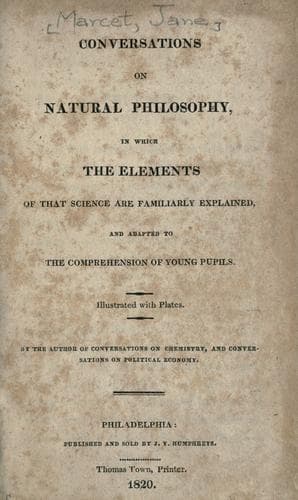
Conversations on Natural Philosophy, in which the Elements of that Science are Familiarly ExplainedMarcet, Mrs. (Jane Haldimand)
Science
Conversations on Natural Philosophy, in which the Elements of that Science are Familiarly Explained
Marcet, Mrs. (Jane Haldimand)
Physics
_Caroline._ Oh, then, Emily, I now understand why the echo of my voice
behind our house is heard so much plainer by you than it is by me, when
we stand at the opposite ends of the gravel walk. My voice, or rather, I
should say, the vibrations of air it occasions, fall obliquely on the
wall of the house, and are reflected by it, to the opposite end of the
gravel walk.
_Emily._ Very true; and we have observed, that when we stand in the
middle of the walk, opposite the house, the echo returns to the person
who spoke.
_Mrs. B._ Speaking-trumpets, are constructed on the principle, that
sound is reflected. The voice, instead of being diffused in the open
air, is confined within the trumpet; and the vibrations which would
otherwise spread laterally, fall against the sides of the instrument,
and are reflected from the different points of incidence, so as to
combine with those vibrations which proceed straight forwards. The
vibrations are thus forced onwards, in the direction of the trumpet, so
as greatly to increase the sound, to a person situated in that
direction. Figure 7, plate 14, will give you a clearer idea, of the
speaking-trumpet; in this, lines are drawn to represent the manner, in
which we may imagine the sound to be reflected. There is a point in
front of the trumpet, F, which is denominated its focus, because the
sound is there more intense, than at any other spot. The trumpet used by
deaf persons, acts on the same principle; although it does not equally
increase the sound.
_Emily._ Are the trumpets used as musical instruments, also constructed
on this principle?
_Mrs. B._ So far as their form tends to increase the sound, they are;
but, as a musical instrument, the trumpet becomes itself the sonorous
body, which is made to vibrate by blowing into it, and communicates its
vibrations to the air.
I will attempt to give you, in a few words, some notion of the nature of
musical sounds, which, as you are fond of music, must be interesting to
you.
If a sonorous body be struck in such a manner, that its vibrations, are
all performed in regular times, the vibrations of the air, will
correspond with them; and striking in the same regular manner on the
drum of the ear, will produce the same uniform sensation, on the
auditory nerve, and excite the same uniform idea, in the mind; or, in
other words, we shall hear one musical tone.
But if the vibrations of the sonorous body, are irregular, there will
necessarily follow a confusion of ærial vibrations; for a second
vibration may commence, before the first is finished, meet it half way
on its return, interrupt it in its course, and produce harsh jarring
sounds, which are called _discords_.
_Emily._ But each set of these irregular vibrations, if repeated alone,
and at equal intervals, would, I suppose, produce a musical tone? It is
only their irregular interference, which occasions discord.
Public-domain text, read in full here on John Shaqi.
Reviews
Reviews
No reviews yet
Be the first to share your thoughts on this work.
Elsewhere in the archive
Join the Discussion
Join the discussion
Sign in to leave a comment or review.
Sign InorCreate an account