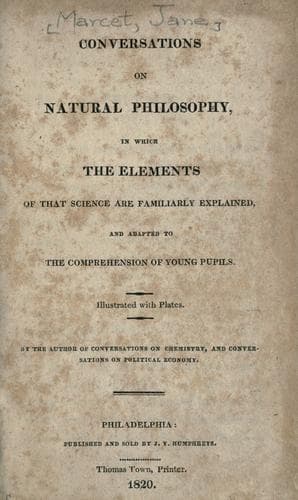
Conversations on Natural Philosophy, in which the Elements of that Science are Familiarly ExplainedMarcet, Mrs. (Jane Haldimand)
Science
Conversations on Natural Philosophy, in which the Elements of that Science are Familiarly Explained
Marcet, Mrs. (Jane Haldimand)
Physics
_Mrs. B._ Certainly. The quicker a sonorous body vibrates, the more
acute, or sharp, is the sound produced; and the slower the vibrations,
the more grave will be the note.
_Caroline._ But if I strike any one note of the piano-forte, repeatedly,
whether quickly or slowly, it always gives the same tone.
_Mrs. B._ Because the vibrations of the same string, at the same degree
of tension, are always of a similar duration. The quickness, or slowness
of the vibrations, relate to the single tones, not to the various sounds
which they may compose, by succeeding each other. Striking the note in
quick succession, produces a more frequent repetition of the tone, but
does not increase the velocity of the vibrations of the string.
The duration of the vibrations of strings, or wires, depends upon their
length, their thickness, or weight, and their degree of tension: thus,
you find, the low bass notes are produced by long, thick, loose strings;
and the high treble notes by short, small, and tight strings.
_Caroline._ Then, the different length, and size, of the strings of
musical instruments, serve to vary the duration of the vibrations, and
consequently, the acuteness or gravity of the notes?
_Mrs. B._ Yes. Among the variety of tones, there are some which, sounded
together, please the ear, producing what we call harmony, or concord.
This arises from the agreement of the vibrations of the two sonorous
bodies; so that some of the vibrations of each, strike upon the ear at
the same time. Thus, if the vibrations of two strings are performed in
equal times, the same tone is produced by both, and they are said to be
in unison.
_Emily._ Now, then, I understand why, when I tune my harp, in unison
with the piano-forte, I draw the strings tighter, if it is too low, or
loosen them, if it is too high a pitch: it is in order to bring them to
vibrate, in equal times, with the strings of the piano-forte.
_Mrs. B._ But concord, you know, is not confined to unison; for two
different tones, harmonize in a variety of cases. When the vibrations of
one string (or other sonorous body) vibrate in double the time of
another, the second vibration of the latter, will strike upon the ear,
at the same instant, as the first vibration of the former; and this is
the concord of an octave.
If the vibrations of two strings are as two to three, the second
vibration of the first, corresponds with the third vibration of the
latter, producing the harmony called, a fifth.
_Caroline._ So, then, when I strike the key-note with its fifth, I hear
every second vibration of one, and every third of the other, at the same
time?
_Mrs. B._ Yes; and the key-note, struck with the fourth, is likewise a
concord, because the vibrations, are as three to four. The vibrations of
a major third, with the key-note, are as four to five; and those of a
minor third, as five to six.
Public-domain text, read in full here on John Shaqi.
Reviews
Reviews
No reviews yet
Be the first to share your thoughts on this work.
Elsewhere in the archive
Join the Discussion
Join the discussion
Sign in to leave a comment or review.
Sign InorCreate an account