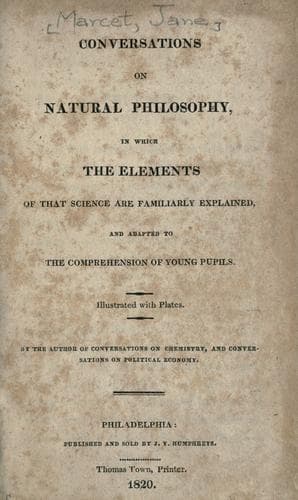
Conversations on Natural Philosophy, in which the Elements of that Science are Familiarly ExplainedMarcet, Mrs. (Jane Haldimand)
Science
Conversations on Natural Philosophy, in which the Elements of that Science are Familiarly Explained
Marcet, Mrs. (Jane Haldimand)
Physics
There are other tones, which, though they cannot be struck together
without producing discord, if struck successively, give us that
succession of pleasing sounds, which is called melody. Harmony, you
perceive, arises from the combined effect of two, or more concordant
sounds, while melody, is the result of certain simple sounds, which
succeed each other. Upon these general principles, the science of music
is founded; but, I am not sufficiently acquainted with it, to enter into
it any further.
We shall now, therefore, take leave of the subject of sound; and, at our
next interview, enter upon that of optics, in which we shall consider
the nature of light, vision, and colours.
Questions
1. (Pg. 146) What is wind, and how is it generally produced?
2. (Pg. 146) How do the winds blow, around the place where the air
becomes rarefied?
3. (Pg. 146) What effect is likely to be produced where the winds meet?
4. (Pg. 147) In what part of the globe is the air most rarefied, and
what is the consequence?
5. (Pg. 147) How do these winds change their direction as they approach
the equator?
6. (Pg. 147) How are the trade-winds produced, and how far do they
extend?
7. (Pg. 147) How is the equilibrium in the air restored?
8. (Pg. 148) How can contrary currents of air be shown in a room?
9. (Pg. 148) What causes this?
10. (Pg. 148) What is meant by a periodical wind?
11. (Pg. 148) What occasions the land and sea breezes, and where do they
prevail?
12. (Pg. 149) What are monsoons?
13. (Pg. 149) How do they change, and what is the cause?
14. (Pg. 149) What is meant by their breaking up, and what effect is in
general produced?
15. (Pg. 149) Why is the wind most variable in high latitudes?
16. (Pg. 150) Why is the wind apt to lessen about sunset?
17. (Pg. 150) What effect must the sun and moon produce upon the
atmosphere, from their attraction?
18. (Pg. 150) Why do not the ærial tides affect the barometer?
19. (Pg. 151) How is sound produced?
20. (Pg. 151) Does sound exist in the sonorous body, if not, what is it?
21. (Pg. 151) By what experiment might we prove that air is the
principal vehicle of sound?
22. (Pg. 152) What other bodies convey sound, and how can it be shown
that they do so?
23. (Pg. 152) What is meant by a sonorous body?
24. (Pg. 152) To what do they owe this property?
25. (Pg. 152) How is this explained by fig. 6, plate 14?
26. (Pg. 152) How is it illustrated by a stone thrown into water, and
how far does this illustration apply?
27. (Pg. 153) How are the vibrations propagated?
28. (Pg. 153) How can we prove that sound, does not travel as rapidly as
light?
29. (Pg. 153) At what rate is sound said to travel?
30. (Pg. 153) Is the velocity much influenced by the direction of the
wind?
31. (Pg. 153) How will sound enable us to judge of the distance of
objects?
32. (Pg. 154) How are echoes produced?
33. (Pg. 154) What is the operation and effect of the speaking-trumpet
(fig. 7, plate 14)?
Public-domain text, read in full here on John Shaqi.
Reviews
Reviews
No reviews yet
Be the first to share your thoughts on this work.
Elsewhere in the archive
Join the Discussion
Join the discussion
Sign in to leave a comment or review.
Sign InorCreate an account