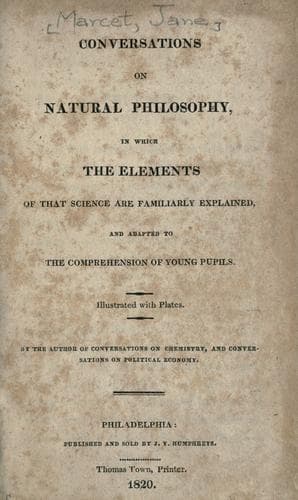
Conversations on Natural Philosophy, in which the Elements of that Science are Familiarly ExplainedMarcet, Mrs. (Jane Haldimand)
Science
Conversations on Natural Philosophy, in which the Elements of that Science are Familiarly Explained
Marcet, Mrs. (Jane Haldimand)
Physics
34. (Pg. 155) How is a musical tone produced?
35. (Pg. 155) What occasions discords?
36. (Pg. 155) Upon what does the acuteness or gravity of a sound depend?
37. (Pg. 155) Does the force, with which a string is struck, affect the
rapidity of its vibrations?
38. (Pg. 155) How are the strings made to produce the high and low
notes?
39. (Pg. 155) What is meant by harmony, or concord, and how is it
produced?
40. (Pg. 156) When are strings said to be in unison?
41. (Pg. 156) How are octaves produced?
42. (Pg. 156) How are fifths produced?
43. (Pg. 156) How major and minor thirds?
44. (Pg. 156) What is meant by melody, and in what particular does it
differ from harmony?
[Illustration: PLATE XV.]
CONVERSATION XIV.
ON OPTICS.
OF LUMINOUS, TRANSPARENT, AND OPAQUE BODIES. OF THE RADIATION OF LIGHT.
OF SHADOWS. OF THE REFLECTION OF LIGHT. OPAQUE BODIES SEEN ONLY BY
REFLECTED LIGHT. VISION EXPLAINED. CAMERA OBSCURA. IMAGE OF OBJECTS ON
THE RETINA.
CAROLINE.
I long to begin our lesson to-day, Mrs. B., for I expect that it will be
very entertaining.
_Mrs. B._ _Optics is that branch of philosophy, which treats of the
nature and properties of light._ It is certainly one of the most
interesting branches of Natural Philosophy, but not one of the easiest
to understand; I must, therefore, beg that you will give me your
undivided attention.
I shall first inquire, whether you comprehend the meaning of a _luminous
body_, an _opaque body_, and a _transparent body_.
_Caroline._ A luminous body is one that shines; an opaque....
_Mrs. B._ Do not proceed to the second, until we have agreed upon the
definition of the first. All bodies that shine, are not luminous; for a
luminous body is one that shines by its own light; as the sun, the fire,
a candle, &c.
_Emily._ Polished metal then, when it shines with so much brilliancy, is
not a luminous body?
_Mrs. B._ No, for it would be dark, if it did not receive light from a
luminous body; it belongs, therefore, to the class of dark, as well as
of opaque bodies, which comprehends all such as are neither luminous,
nor will admit the light to pass through them.
_Emily._ And transparent bodies, are those which admit the light to pass
through them, such as glass and water.
_Mrs. B._ You are right. Transparent, or pellucid bodies, are frequently
called mediums, because they allow the rays of light to pass through
them; and the rays which pass through, are said to be transmitted by
them.
Light, when emanated from the sun, or any other luminous body, is
projected forward in straight lines, in every possible direction; so
that the luminous body, is not only the general centre, from whence all
the rays proceed; but every point of it, may be considered as a centre,
which radiates light in every direction. (Fig. 1, plate 15.)
_Emily._ But do not the rays which are projected in different
directions, and cross each other, interfere, and impede each other's
course?
Public-domain text, read in full here on John Shaqi.
Reviews
Reviews
No reviews yet
Be the first to share your thoughts on this work.
Elsewhere in the archive
Join the Discussion
Join the discussion
Sign in to leave a comment or review.
Sign InorCreate an account