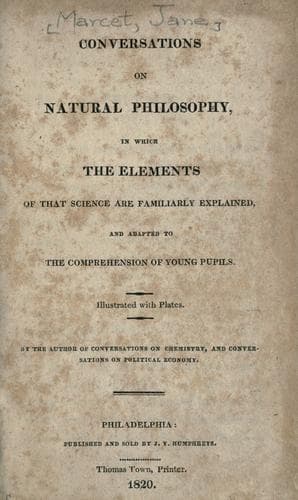
Conversations on Natural Philosophy, in which the Elements of that Science are Familiarly ExplainedMarcet, Mrs. (Jane Haldimand)
Science
Conversations on Natural Philosophy, in which the Elements of that Science are Familiarly Explained
Marcet, Mrs. (Jane Haldimand)
Physics
_Mrs. B._ Not at all. The particles of light, are so extremely minute,
that they are never known to interfere with each other. A ray of light,
is a single line of light, projected from a luminous body; and a pencil
of rays, is a collection of rays, proceeding from any one point of a
luminous body, as fig. 2.
_Caroline._ Is light then a substance composed of particles, like other
bodies?
_Mrs. B._ That is a disputed point, upon which I cannot pretend to
decide. In some respects, light is obedient to the laws which govern
bodies; in others, it appears to be independent of them: thus, though
its course is guided by the laws of motion, it does not seem to be
influenced by those of gravity. It has never been discovered to have
weight, though a variety of interesting experiments have been made with
a view of ascertaining that point; but we are so ignorant of the
intimate nature of light, that an attempt to investigate it, would lead
us into a labyrinth of perplexity, if not of error; we shall, therefore,
confine our attention to those properties of light, which are well
ascertained.
Let us return to the examination of the effects of the radiation of
light, from a luminous body. Since the rays of light are projected in
straight lines, when they meet with an opaque body through which they
are unable to pass, they are stopped short in their course; for they
cannot move in a curve line round the body.
_Caroline._ No, certainly; for it would require some other force besides
that of projection, to produce motion in a curve line.
_Mrs. B._ The interruption of the rays of light, by the opaque body,
produces, therefore, darkness on the opposite side of it: and if this
darkness fall upon a wall, a sheet of paper, or any object whatever, it
forms a shadow.
_Emily._ A shadow, then, is nothing more than darkness produced by the
intervention of an opaque body, which prevents the rays of light from
reaching an object behind it.
_Caroline._ Why then are shadows of different degrees of darkness; for
I should have supposed, from your definition of a shadow, that it would
have been perfectly black?
_Mrs. B._ It frequently happens that a shadow is produced by an opaque
body, interrupting the course of the rays from one luminous body, while
light from another, reaches the space where the shadow is formed; in
which case, the shadow is proportionally fainter. This happens when the
opaque body is lighted by two candles: if you extinguish one of them,
the shadow will be both deeper, and more distinct.
_Caroline._ But yet it will not be perfectly dark.
_Mrs. B._ Because it is still slightly illuminated by light reflected
from the walls of the room, and other surrounding objects.
You must observe, also, that when a shadow is produced by the
interruption of rays from a single luminous body, the darkness is
proportioned to the intensity of the light.
Public-domain text, read in full here on John Shaqi.
Reviews
Reviews
No reviews yet
Be the first to share your thoughts on this work.
Elsewhere in the archive
Join the Discussion
Join the discussion
Sign in to leave a comment or review.
Sign InorCreate an account